A garden that remains attractive in January as well as in August relies less on the choice of flowers than on understanding the soil, the water cycle, and plant succession. Creating a flourishing garden year-round involves coordinating three technical levers: soil structure, water management, and the selection of plants whose periods of interest alternate season after season.
Soil Structure and Drainage: The Foundation of a Flourishing Garden Year-Round
Before planting anything, the soil deserves a simple diagnosis. Clay soil retains water in winter and cracks in summer. Sandy soil allows nutrients to wash away. The texture directly affects the health of plants over twelve months.
To assess the texture, simply take a handful of moist soil and roll it between your fingers. If it forms a smooth sausage shape, clay is dominant. If it crumbles, sand predominates. This test guides everything else: amendments, plant choices, and watering frequency.
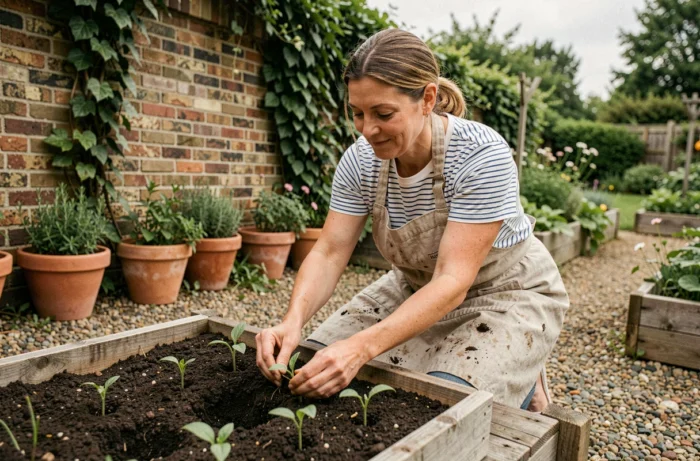
A compact soil benefits from the addition of well-rotted compost incorporated into the top twenty centimeters. Compost improves both the water retention of sandy soils and the drainage of clay soils. Working the soil in autumn, when it is still pliable, allows microorganisms to digest organic matter before spring.
Additionally, you will find useful information on Le Jardineur to delve deeper into each step of land preparation according to your regional context.
Water Management in the Garden: Regulations and Concrete Watering Solutions
Climate adaptation has become a central criterion in garden design. The Ifop barometer for Unep from March 2025 confirms this trend. Saving water is no longer a choice; it is a design constraint.
Rainwater Harvesting and Legal Framework
The decree of July 12, 2024, has classified rainwater as non-potable, while specifying its permitted uses: watering non-professional vegetable gardens, green spaces, and green roofs.
Installing a rainwater harvesting tank does not exempt you from checking local prefectural decrees. Depending on the drought alert level, watering may be limited to certain hours, restricted, or completely prohibited, even with stored rainwater. The Vigieau system allows you to know the level of restrictions in effect in your municipality.
Reducing Dependence on Watering
Organic mulching (wood chips, dead leaves, straw) limits evaporation and maintains stable moisture at the base of plants. A layer of five to ten centimeters is sufficient to significantly reduce watering frequency in summer.
- Mulch starting in May, before the first heat, to retain moisture accumulated in spring.
- Favor drip irrigation over sprinklers, as slow diffusion reduces runoff and targets the roots.
- Group plants by water needs (hydrozoning) to avoid over-watering drought-resistant plants while trying to satisfy the more thirsty ones.
Drought and Frost Resistant Plants: A Garden Beautiful in Every Season
Plant succession is the principle that ensures permanent visual interest. The idea is to combine species whose blooms, fruiting, or decorative foliage alternate throughout the year.
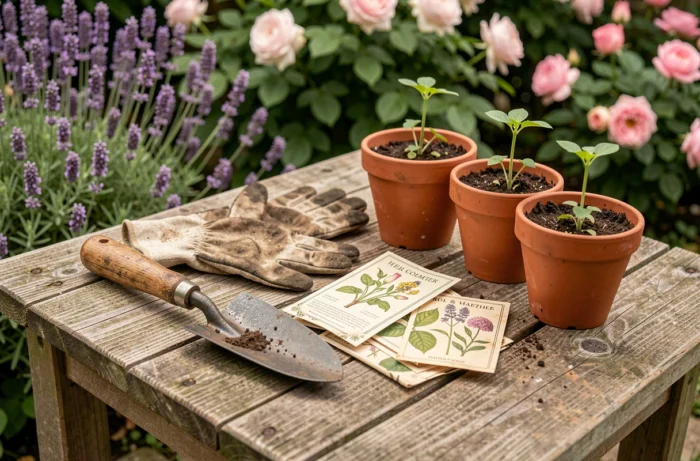
Plants known as “bi-resistant,” capable of withstanding both summer droughts and marked winter frosts, form the backbone of a low-maintenance garden. Rustic Mediterranean perennials form the foundation of a resilient garden. Lavender, rosemary, shrubby sages, or ornamental grasses like blue fescue tolerate both dryness and moderate cold.
To structure the succession season by season, a summary table helps visualize the transitions:
| Season | Plants of Interest | Main Attraction |
|---|---|---|
| Winter | Hellebores, red-twig dogwood, winter heathers | Winter blooms, colorful bark |
| Spring | Bulbs (daffodils, tulips), lilacs, wisteria | Abundant blooms, fragrance |
| Summer | Lavender, agapanthus, grasses | Long blooms, heat resistance |
| Autumn | Asters, sedums, winged euonymus | Foliage colors, late blooms |
A garden composed of at least two to three species per season in this table will never experience a “blank” period.
Biodiversity in the Garden: Concrete Actions That Change the Ecosystem
Encouraging beneficial wildlife has a direct effect on maintenance. Ladybugs and lacewings naturally regulate aphids. Hedgehogs limit slug populations. Attracting these allies does not require a wild garden, but rather some targeted adjustments.
- Leave a pile of dead wood or leaves in a discreet corner to provide winter refuge for insects and small mammals.
- Install a water point, even modest (a dish filled with gravel and water), to attract pollinators and birds.
- Sow a flowering strip composed of local nectar-producing plants (phacelia, crimson clover, borage) along a flower bed or vegetable garden.
- Space out mowing on part of the lawn to allow wildflowers to go to seed.
These actions require little time and gradually reduce the need for treatments, as the biological balance self-regulates more each year.
A flourishing garden year-round does not rely on an accumulation of spectacular varieties, but on three decisions made in advance: knowing your soil, planning water management before planting, and choosing plants whose periods of interest complement each other. The rest, biodiversity takes care of in part.