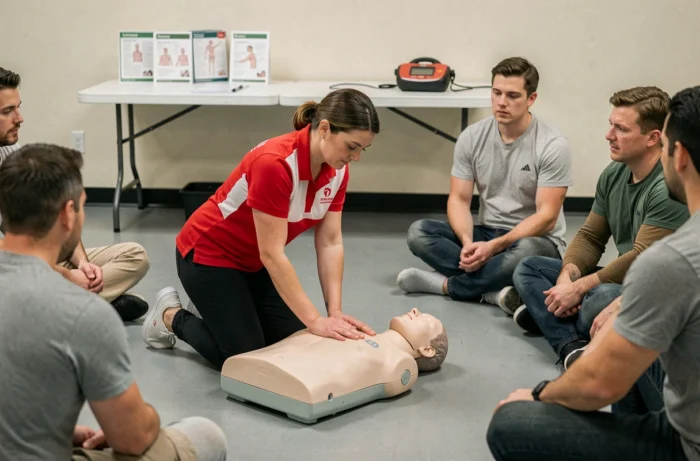
A first aid trainer is not limited to demonstrating technical gestures in front of a group. Their role is based on a precise regulatory framework, articulated around pedagogical certificates issued under the control of the State and authorized organizations. Each pathway (general public, professional environment, rescue teams) has its own access requirements, skills maintenance, and administrative traceability.
SST Trainer Certificate and FORPREV Platform: the Administrative Foundation to Understand
The Workplace First Aid Rescuer (SST) pathway is structured by the INRS and Health Insurance. The SST trainer does not work solo: they must operate within a training organization authorized by the Health Insurance – Professional Risks network.
All management of sessions, certificates, and trainer follow-up goes through FORPREV, the dedicated national tool. The organization must declare each session there, link its active trainers, and record the results. Without the organization’s authorization on FORPREV, the trainer simply cannot practice in SST, even if they hold the certificate.
This point is often overlooked in orientation paths. Obtaining the SST trainer certificate is not enough: it is also necessary to ensure that the hosting structure has its authorization up to date. To better understand the entire pathway, it is possible to visit the Soutien Adom website which details the various access routes to the profession.

PAE FPSC, PAE FPS, and PAE FPSE: Pedagogical Certificates by Pathway
The generic term “first aid trainer” actually covers several distinct certificates, each granting different teaching rights.
- The PAE FPSC (Applied Pedagogy for Employment as a First Aid Trainer) allows training the general public in PSC1. It is obtained from an organization approved by the Ministry of the Interior.
- The PAE FPS (First Aid Trainer) allows overseeing PSE1 and PSE2 training intended for rescue team members, in an associative or civil security framework.
- The SST trainer certificate, awarded after specific training, exclusively concerns prevention and first aid in the professional environment, under the aegis of the INRS.
These certificates are not interchangeable. An SST trainer cannot teach PSC1, and a holder of the PAE FPSC cannot train workplace first aid rescuers. The choice of pathway determines the target audience, legal framework, and renewal obligations.
Common Prerequisites for All Pathways
Regardless of the targeted certificate, the candidate must first hold the first aid diploma corresponding to the level they wish to teach (PSC1, active SST, PSE1/PSE2). Practical first aid experience, acquired in an association or company, is a foundation expected by training organizations for trainers.
Validity Limited to 36 Months and Skills Maintenance: What Changes the Practice of the Profession
The SST trainer certificate has a validity period of 36 months. Beyond this period, without skills maintenance and updating training (MAC), the trainer loses their right to practice. The same logic applies to other pathways, with varying recycling cycles.
This constraint transforms the daily life of the trainer. It is not a diploma acquired once and for all, but a skill that must be regularly reactivated. The trainer must plan their MAC sessions, verify that their host organization also maintains its authorization, and ensure that their FORPREV profile is up to date.
Traceability and Documentary Obligations
The rise of tools like FORPREV or associative management platforms (eBrigade, LOFOS) imposes a new administrative rigor. Each session delivered must be documented, and each certificate issued must be traceable. The trainer manages as many administrative files as practical scenarios.
This aspect sometimes deters candidates who imagine a profession solely focused on the field. The reality of the first aid trainer includes managing attendance lists, ensuring that teaching materials comply with national standards, and tracking the certificates issued to trainees.
Ministerial Approval and Authorization: Two Distinct Concepts for Teaching First Aid
Approval is granted by the Ministry of the Interior to associations and organizations wishing to provide first aid training to the general public (notably PSC1). The SST authorization, on the other hand, falls under Health Insurance via the INRS and concerns the professional environment.
An independent trainer cannot obtain these approvals or authorizations personally. They must operate under the responsibility of an approved or authorized structure. This particularity distinguishes first aid from many other areas of professional training, where a trainer can declare themselves alone with an activity declaration number.
Activity Declaration Number and Exception for Trainer Training
Every training organization must, in principle, have an activity declaration number (NDA) with the DREETS. However, first aid trainer training is explicitly excluded from this declaration obligation. This regulatory detail, rarely mentioned, eases the processes for structures that exclusively train trainers without providing training to the final public.
The pathway to becoming a first aid trainer thus combines a targeted pedagogical certification, affiliation with an authorized or approved organization, and a commitment to a skills maintenance cycle every 36 months for the SST pathway. Mastering life-saving gestures remains the prerequisite, but the profession now hinges as much on regulatory compliance as on pedagogy.