The daily flourishing of children is not limited to a list of good parenting practices. Behind this broad formulation lie precise mechanisms related to the physical environment, bodily habits, and the development of internal skills that the child mobilizes every day. Understanding these levers allows for action on concrete points rather than following generic injunctions.
Children’s psychosocial skills: a framework that goes beyond perceived well-being
Recent approaches to child well-being have shifted from a vague goal (happiness, serenity) to the development of identified psychosocial skills that are repeatedly practiced. Self-confidence, stress management, empathy, cooperation, motivation: these abilities are not acquired simply through exposure to a pleasant family climate.
Structured educational toolboxes now offer short, reproducible, and adaptable activities for all contexts (family, school, leisure centers). The idea is not to multiply workshops but to repeat targeted micro-exercises focusing on one skill at a time.
A child who learns to name their emotions through a daily card game progresses differently from one who is simply told to “calm down.” Resources compiled on the child page of Douceur Enfance illustrate this logic of structured support, providing guidelines suitable for each age.
Field feedback varies on the optimal rhythm of these activities. Some childhood professionals recommend daily sessions of a few minutes, while others prefer two to three longer weekly sessions. What is agreed upon is the importance of regularity over intensity.
Home environment and autonomy: the material adjustments that matter
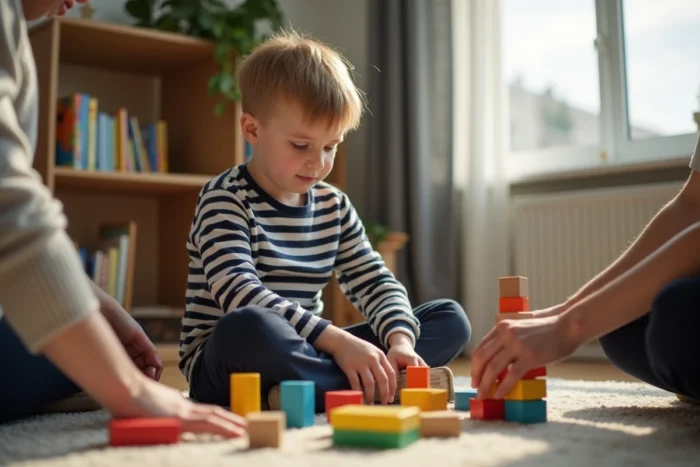
The arrangement of a child’s living space directly influences their concentration ability and stress level. Research inspired by Montessori pedagogy and domestic ergonomics highlights very specific material adjustments as observable levers for reducing anxiety.
Among the most documented modifications:
- Favoring a palette of soft colors in the play and rest area, avoiding aggressive visual contrasts that overstimulate the child
- Installing child-height storage to promote autonomy in choosing and organizing toys and books
- Practicing regular rotation of accessible games and books, rather than leaving everything available at all times
- Adapting lighting in the evening with dimmed light to support the transition to calm
These choices are not merely decorative. A child who can independently grab a book, choose an activity without help, and then tidy up develops a sense of competence that nurtures their self-esteem. The rotation of toys, in particular, reduces the feeling of saturation and reignites curiosity without additional purchases.
Limitations of the environmental approach
Creating an ideal space is not enough if the pace of life does not follow suit. A calming environment loses its effect when transitions between activities are abrupt or when the child’s schedule is overloaded. The physical space and daily tempo work together.
Daily physical activity and children’s mental health
The World Health Organization recommends at least 60 minutes of moderate to vigorous physical activity per day for children aged 5 to 17. This recommendation targets not only physical fitness but also directly addresses the prevention of distress and anxiety disorders.
The link between movement and emotional balance is now well established in health sports initiatives. Limiting screen time fits into this same prevention logic. A sedentary child is not just less physically fit; they have fewer resources to regulate their emotions.
Integrating movement without making it a constraint
The trap would be to turn this recommendation into a rigid sporting injunction. Walking to school, playing freely in a park, dancing in the living room count just as much as a structured swimming session. Spontaneous and varied movement takes precedence over structured activity for younger children.
Families that integrate movement into daily routines (walking trips, physical play after school, stretching before bed) report benefits for their children’s sleep and emotional management. However, the available data do not allow for concluding that one type of physical activity is superior to another for psychological well-being.
Daily routines and rituals: what structures without rigidifying
The daily routine provides the child with a predictable framework that reduces anxiety related to the unknown. Morning and evening rituals play a particular role in this daily architecture.
Four morning gestures frequently appear in feedback from families observing lasting change in their children: a time for physical connection (hug, contact), a verbal exchange about the upcoming day, a breakfast taken together without screens, and a moment of choice left to the child (clothes, evening activity).
The ritual works when it remains flexible in form but stable in presence. A child who knows they will have a time for exchange in the morning tolerates schedule variations better. Excessive rigidity in the routine produces the opposite effect: it generates stress as soon as an unexpected event occurs.
Adapting routines according to age
A three-year-old child needs visual cues (images, sequences displayed on the wall) to follow a routine. An eight-year-old can co-construct their schedule and integrate their own choices. Autonomy in managing the routine grows with the child, and this progression is part of the flourishing process.
The most recent approaches emphasize a often overlooked point: a child who participates in the construction of their rituals internalizes them more durably than one who merely endures them. Offering two options rather than imposing a single sequence is often enough to transform resistance into adherence.
Daily flourishing relies less on abstract educational principles and more on material choices, bodily habits, and micro-rituals tailored to each child. Opportunities for progress lie in the details of the environment and rhythm, not in a universal method.