The Raku glazing technique is based on a simple principle: removing a ceramic piece from the kiln at high temperature, then subjecting it to a sudden cooling through smoking or immersion in water. This thermal shock causes cracks in the glaze layer, a visual signature of the technique. The beauty of these fissures poses a concrete problem as soon as one considers a use beyond the purely decorative.
Preparation of the bisque before Raku glazing
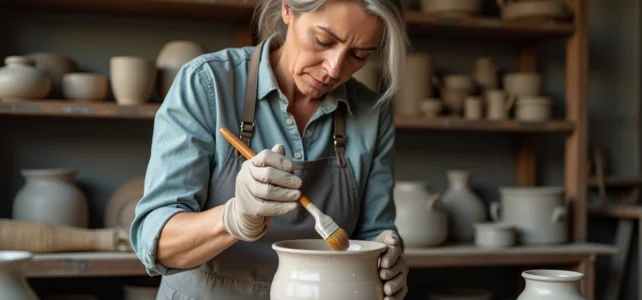
The quality of a Raku glaze is determined even before the application of the first layer. The bisque (the piece after the first firing) must be rigorously prepared; otherwise, the glaze will chip off after the thermal shock.
Dusting is the first step. Any residual particle prevents the glaze from adhering to the porous surface of the earthenware. A wipe with a damp sponge is sufficient, provided one waits for complete drying before glazing.
Feedback from workshops shows that the preparation of the bisque influences the result more than the choice of glaze recipe. A consistent application on a clean, dry bisque reduces the risk of chipping much more effectively than formula adjustments. By consulting the tips from Les Embellies Déco, one can see this logic of controlled layering between slip, intermediate layer, and final glaze.
The thickness of application deserves particular attention. If too thin, the layer does not vitrify properly and the cracked effect remains dull. If too thick, it runs during firing and forms irregular clumps. The right thickness can be checked by touch: the surface should feel like an eggshell before firing.
Slip, glaze, and surface decoration: a layering logic
In Raku, three types of layers coexist on a piece, and confusing them leads to disappointing results.
- The slip is a colored liquid clay applied before glazing. It modifies the background hue and the adhesion of the glaze without forming a vitrified surface itself.
- The actual glaze is the layer that vitrifies during firing. It is what produces the characteristic crackle during the thermal shock.
- The surface decoration (metallic oxides, salts) sometimes intervenes between the slip and the glaze, or on the raw glaze, to create localized color effects.
The order of these layers is not interchangeable. A slip applied over a glaze will not withstand firing. An oxide applied under a slip that is too thick will be invisible. Each layer has a precise technical function, and the beauty of the result comes from their interaction during the sudden cooling.
Raku firing and thermal shock: what happens in the kiln
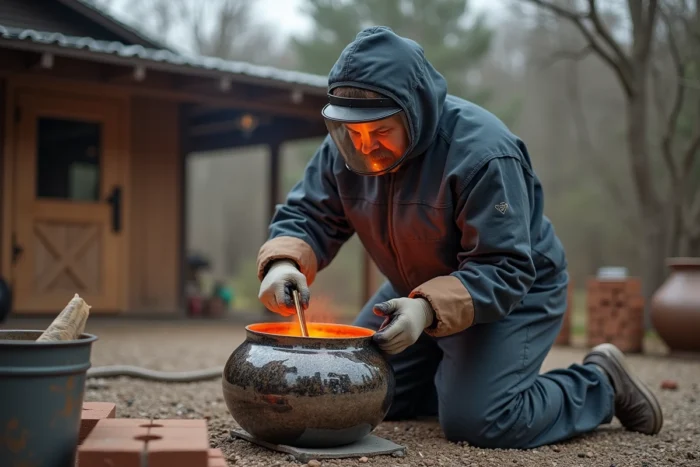
Raku firing is a fast low-temperature firing. The kiln heats up until the glaze melts and becomes shiny. The piece is then extracted hot with long tongs.
Immediately after leaving the kiln, the piece is plunged into a container filled with combustible materials (wood shavings, newspaper, dry leaves). These materials ignite upon contact with the hot ceramic. The container is closed to cut off the air supply and create a reduction atmosphere.
It is this reduction that gives Raku glazes their metallic reflections. The metallic oxides present in the glaze react differently depending on the amount of oxygen available: copper can turn red or green, while iron produces deep blacks. Unglazed areas absorb smoke and darken, creating a contrast with the vitrified areas.
Variability of the result
Each Raku firing produces a different result. The duration of smoking, the nature of the fuel, the exact temperature at the moment of extraction, the outside wind: all these parameters modify the final outcome. Strict repeatability is incompatible with the Raku process. This variability is part of the identity of the technique, but it poses a real problem for any mass production or specific specifications.
Food use of Raku pieces: crackle and leaching
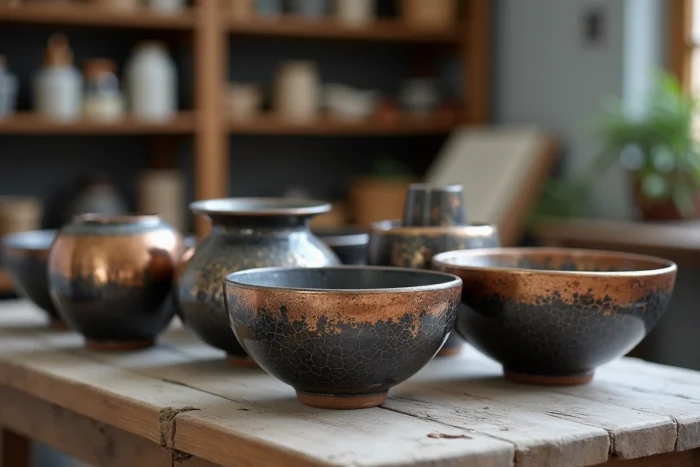
The question often arises: can a Raku bowl or cup be used for eating or drinking? The technical answer is straightforward: the crackle makes the surface porous and therefore unsuitable for food contact without laboratory testing.
The cracks in the glaze, no matter how fine, create micro-channels where liquids can penetrate. These channels can harbor bacteria and, depending on the composition of the glaze, release metallic oxides through leaching. Lead and barium, sometimes present in traditional formulas, are the most closely monitored.
Some ceramicists offer “food-safe” glazes for Raku, but this designation is only valid if the finished piece (not just the recipe) has been tested in a laboratory after firing and smoking. The reduction firing alters the surface chemistry in unpredictable ways, invalidating any guarantee based solely on the initial composition of the glaze.
Securing a Raku glaze for decorative use
For strictly decorative use, the constraints are less but not nonexistent. A vase intended to hold water and flowers must withstand prolonged humidity without the glaze peeling off. Some concrete precautions include:
- Choosing a chamotte clay that can withstand thermal shocks without deep cracking.
- Applying the glaze on a perfectly dry and dust-free bisque to maximize adhesion.
- Limiting the glaze thickness to areas that will not be in prolonged contact with liquid.
- Testing the piece by leaving it filled with water for several days: if stains appear on the bare clay, the sealing is insufficient.
Raku remains a technique where the final result partially escapes the control of the ceramicist. The tension between the beauty of the crackle and safety requirements cannot be resolved by a miracle recipe, but by a clear understanding of what each piece can and cannot withstand. Any Raku glaze intended for functional use requires testing of the finished piece, not just the formula.