
Solo business development requires constantly balancing prospecting, client follow-up and administrative management. Since France’s e-invoicing reform, that balance has become more complicated: receiving electronic invoices will be mandatory from September 1, 2026, and issuing them is scheduled to become mandatory from September 1, 2027, for SMEs, small businesses and micro-enterprises.
Managing sales on your own now means building these regulatory requirements into your routines—not just improving your prospecting.
E-invoicing and business development: what’s changing in practice
Most guides to sales organization treat invoicing as a secondary task. For a solo business owner who sells, invoices and follows up with clients, it is a central link in the sales cycle.
The reform requires structured data formats (Factur-X, UBL or CII). A simple PDF sent by email does not meet this requirement. This means that self-employed professionals should check now whether their invoicing tool can generate these formats and whether it integrates with their accounting and client-tracking systems.
For those whose business serves French business clients, individual consumers and international clients, there is another process to consider: e-reporting for sales outside French B2B transactions. Transaction data must be submitted according to specific rules. Overlooking this could mean discovering a gap in your closing routines at the worst possible time.
Choosing an approved platform is about more than buying software. It is an organizational decision that affects archiving, payment tracking and accounting compliance. It is better to organize your solo business development with this requirement in mind from the outset than to cobble together a solution at the last minute.
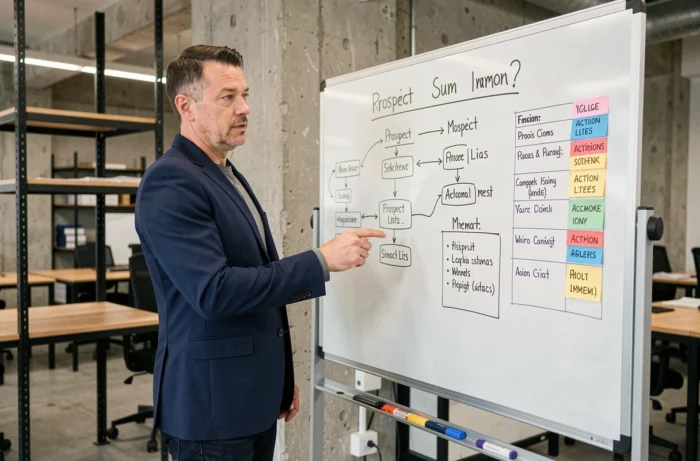
Prioritizing sales tasks when you wear every hat
When you work alone, your weekly to-do list can quickly exceed what a single day can accommodate: prospecting, follow-ups, meetings, proposal writing, after-sales support and administration. The natural instinct is to tackle whatever seems urgent. The problem is that urgent tasks (a client calling back, an invoice to correct) consistently push aside the work that generates revenue in the medium term.
Separate delivery from business development
Prospecting and pipeline follow-up generate future revenue, while delivery (providing the service you sold) generates revenue now. Solo business owners need to protect fixed time slots for the former, even when the latter piles up.
A simple approach is to block out two or three time slots each week exclusively for business development. No client delivery, no admin during these slots. Use the rest of your time for delivery and management.
Rank tasks by their impact on the pipeline
Not all sales tasks are equally valuable. Following up with a warm prospect who requested a quote is more likely to produce results than sending a cold prospecting email to an unqualified list. A weekly review helps you focus your energy where the likelihood of conversion is highest.
- Follow up on quotes outstanding for fewer than ten days: top priority, as the prospect has shown recent interest.
- Discovery meetings with qualified contacts: each meeting feeds the pipeline for the coming weeks.
- Cold prospecting (emails, calls, social networks): do it in batches during a dedicated time slot to avoid distractions.
- CRM updates and administrative follow-up: group these at the end of the day or week to avoid breaking up productive hours.
Automate or do it yourself: finding the break-even point
Automating sales processes comes at a cost (software subscriptions, setup time and a learning curve). Doing everything manually does too, but that cost is invisible: it shows up as wasted hours and missed tasks.
Automation becomes worthwhile when the time spent on a repetitive task exceeds the time needed to set up the tool that replaces it. For a self-employed professional, this threshold is often reached in three specific areas.
Follow-ups and nurture sequences
Manually sending a follow-up email three days after a quote, then another ten days later, works when you have five prospects. Beyond that, things start to slip through the cracks. A sequencing tool (included in most CRMs) sends these emails automatically. The benefit is not just the time saved: consistent follow-up also increases conversion rates.
Invoicing and compliance
With the introduction of structured e-invoicing, the initial setup of a Factur-X- or UBL-compatible tool takes a few hours. In return, every invoice you issue complies with the legal format, is archived correctly and feeds into your accounting without manual re-entry. The cost of non-compliance far outweighs the subscription fee for an approved platform.
Reporting and dashboards
Tracking sales in a spreadsheet works when you’re just starting out. As your volume of contacts and transactions grows, a CRM with a built-in dashboard lets you view your pipeline, conversion rates and forecasts without spending half a day on it every week.

Weekly closing routines to stay on track
Solo sales organization tends to break down through a series of small oversights: a contact not followed up, an invoice not issued, a prospect forgotten in the CRM. The most reliable safeguard is a short but consistent closing routine.
At the end of each week, a 30-minute review is enough to cover the following points:
- Check that every quote sent has a follow-up date scheduled in the CRM or tracking tool.
- Issue invoices for completed services, making sure they use the required structured format.
- Identify prospects added to the pipeline this week and assign each a specific next action.
- Check transactions subject to e-reporting (sales to individual consumers and clients outside France) to avoid falling behind.
Thirty minutes of weekly closing can save hours of catch-up at the end of the month. This routine turns a pile of tasks into a predictable process—the only structural advantage a solo business owner can build against a sales team.
Solo business development is not about the number of actions you take, but your ability to maintain a steady cycle of prospecting, conversion and administrative compliance. As e-invoicing is phased in, choosing the right tools and maintaining disciplined routines become decisions just as strategic as targeting prospects.