The security of a home is based on a simple principle: every unprotected access point negates the efforts made on all the others. Effectively securing your home on a daily basis goes beyond just installing an alarm on the front door. The best tips combine physical reinforcement of access points, discreet habits, and checking insurance coverage.
Forgotten secondary accesses: the weak link in home security
Competitors talk about front doors and ground floor windows. They overlook secondary accesses, which are the preferred entry points when the rest is locked.
The roof windows, basement doors, and garage accesses represent common vulnerabilities. A garage communicating with the house without a reinforced lock offers a discreet passage, often invisible from the street. Basement doors, equipped with a simple latch, can be forced open in a matter of seconds.
To cover these areas, a methodical approach works better than a massive investment in the main door. Conduct a complete tour of your home, listing every opening, including those that no one thinks about (crawl space hatch, laundry window leading to a back yard). For more in-depth solutions for securing each type of access, a useful resource: https://www.homedome.fr/.
Just one uncovered access is enough to compromise the security of the entire home. Before purchasing expensive equipment, ensure that all openings have at least a sturdy mechanical lock.
Locks and doors: the technical criteria to check
Not all locks are created equal. The A2P standard, issued by the CNPP, classifies locks into three levels of resistance to burglary. A lock without A2P certification does not guarantee any minimum resistance time against a picking tool.
- A2P one star: resistance to burglary for a few minutes, suitable for interior or secondary doors
- A2P two stars: intermediate resistance, recommended for entrance doors of homes in urban areas
- A2P three stars: maximum level, often required by insurers for isolated homes or those containing declared valuable goods
Beyond the lock, the material of the door matters. A three-star lock mounted on a hollow core door remains vulnerable. The door set (door plus frame plus lock) must be consistent in its level of resistance. Hinge protectors, often overlooked, prevent removal from the outside.
Alarm and video surveillance: what the equipment doesn’t tell you
Installing an alarm system significantly reduces the risk of intrusion. Burglars spot equipped homes and prefer easier targets. A system covering the entire home (and not just the ground floor) remains the most deterrent configuration.
Connected alarm or local alarm
A local alarm emits a siren. It alerts the neighborhood, but no one intervenes if the house is isolated. A connected alarm to a monitoring center triggers a verification call, followed by a call to law enforcement if the intrusion is confirmed. The monthly cost of a monitoring subscription varies depending on the providers and the options chosen.
Video surveillance and legal limits
Surveillance cameras facing public roads are prohibited for individuals. The field of vision must be limited to your property. Furthermore, the interpretation of surveillance images has biases: an innocuous movement can trigger an alert, and a real intrusion can go unnoticed if the coverage angle is poorly calibrated.
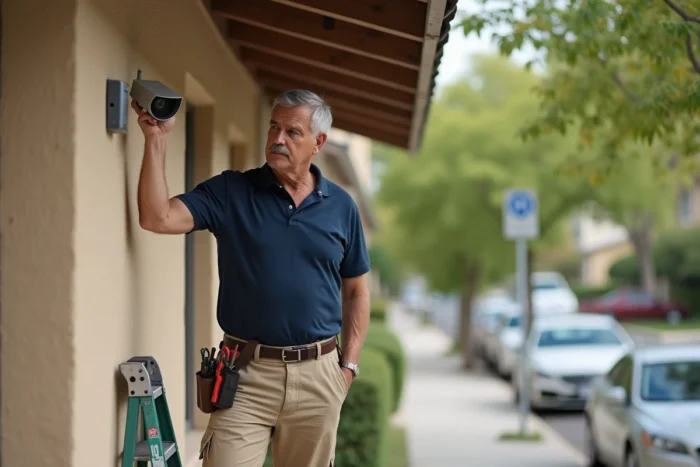
Place cameras high, directed towards the accesses (front door, gate, garage), and regularly check that the recording is functioning. A poorly maintained video surveillance system gives a false sense of security.

Home insurance: the often-overlooked financial security
Equipment protects against intrusion. Home insurance protects against financial consequences. These two aspects are complementary, but the latter is rarely checked rigorously.
Several common situations are not covered by a standard contract:
- Theft without visible break-in (door left open, key under the doormat) is excluded by most contracts
- Undeclared valuable items (jewelry, computer equipment, art objects) are capped at amounts often lower than their actual value
- Deductibles vary greatly from one contract to another and can make compensation trivial for a small burglary
Review the exclusions and limits of your contract at least once a year, especially after acquiring new equipment or valuable items. Some insurers impose specific requirements (A2P lock, certified alarm) to maintain theft coverage.
Simulating presence: the gestures that matter daily
Burglars target homes that appear unoccupied. During vacations, a full mailbox and permanently closed shutters signal a prolonged absence.
Light timers allow you to turn lamps on and off at variable times. The idea is to mimic the actual habits of the occupants: living room lit in the evening, bedroom at night. Simulating presence remains one of the least expensive and most deterrent measures.
Asking a neighbor to collect the mail, park their car in the driveway occasionally, or vary the position of the shutters adds a layer of credibility. Collaboration between neighbors works particularly well in residential areas where homes are visible from the street.
Securing a home never relies on a single device. It is the combination of reinforced accesses, a well-sized alarm system, verified insurance, and discreet habits that tangibly reduces risk. The most cost-effective starting point often remains the simplest: walk around your house with fresh eyes and identify what an intruder would see first.