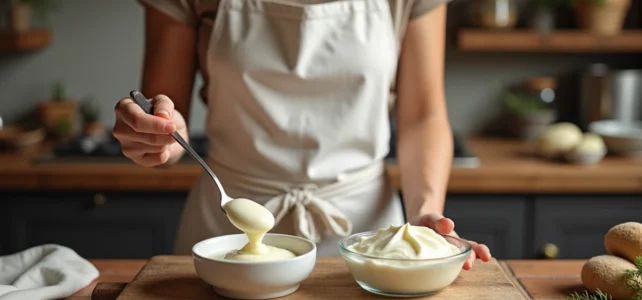
Crème fraîche and mascarpone share a milky appearance and a creamy texture, but their production, composition, and behavior in cooking differ in several technical aspects. Crème fraîche is a dairy fat obtained by skimming milk, and it may be inoculated with lactic ferments. Mascarpone, on the other hand, is an Italian fresh cheese made from heated and acidified cream, which gives it a denser consistency and a milder taste.
Understanding these differences allows for making the right choice depending on the intended recipe, whether for a sauce, a dessert, or a frosting.
Fats and acidity: what really separates these two dairy products
The first distinguishing criterion is the fat content. Mascarpone has a significantly higher richness than most commercial crème fraîches. This concentration of fat gives it a thick and silky texture that holds without collapsing.
Crème fraîche, on the other hand, covers a much broader spectrum. In France, the term encompasses very different products: raw, pasteurized, thick, fluid, light cream. The specifications vary between labels (AOP Isigny, mention Montagne, etc.), which explains why two crème fraîches can behave very differently when cooking or whipping.
The other variable is acidity. Thick, fermented crème fraîche brings a slight acidic note that enhances savory dishes. Mascarpone, acidified differently during its production, remains neutral in taste. It rounds out flavors instead of cutting them.
The choice between crème fraîche or mascarpone therefore depends as much on the desired fat content as on the flavor profile sought in the finished dish.
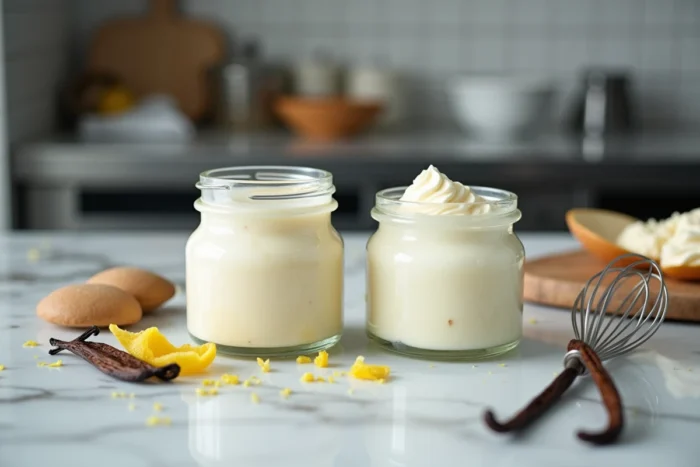
Cooking behavior: sauces, gratins, and hot dishes
When heated, these two products do not react the same way. Thick crème fraîche withstands prolonged cooking well: it thickens sauces without breaking down, as long as it is not boiled too vigorously. Liquid cream, on the other hand, serves as a base for reductions and light sauces.
Mascarpone melts quickly and adds body without acidity. Incorporated at the end of cooking into pasta, risotto, or soup, it gives a richer and rounder result than classic crème fraîche. However, it does not reduce as well as liquid cream because its fresh cheese structure behaves differently under continuous heat.
For gratins and quiches, crème fraîche remains the most practical choice. Its fluidity (liquid version) allows for a homogeneous binding of an egg-based mixture, while mascarpone needs to be diluted beforehand to avoid lumps.
When mascarpone has the advantage in savory dishes
In creamy sauces for pasta without long cooking, mascarpone blends directly with the residual heat of the drained pasta. The result is a satin coating, thicker than with cream. This is also an asset in savory verrines served cold, where its stability prevents the collapse that a liquid cream would cause.
Desserts and whipped cream: stability versus lightness
Whole liquid crème fraîche is the classic base for whipped cream. Whipped cold, it increases in volume and gives an airy mousse. The problem: this whipped cream deflates quite quickly, especially outside the refrigerator.
This is the precise point where trends in pastry have evolved. More and more pastry chefs use a mixture of mascarpone and whole liquid cream to create a mascarpone whipped cream, which is more stable and better suited for layer cakes, cupcakes, and tiered cakes. Mascarpone adds structure and better resistance to transport and refrigeration.
The commonly used ratio is about one volume of mascarpone to two volumes of liquid cream, whipped together. The result holds longer without losing its lightness, making it an interesting compromise between pure whipped cream and a cream cheese frosting.
Tiramisu, mousses, and creams: the domain of mascarpone
For desserts where the texture must remain dense and creamy without cooking, mascarpone is hard to replace. Tiramisu relies entirely on its ability to bind with egg yolks and sugar without adding water or diluting the flavor. Thick crème fraîche can be a substitute, but it introduces an acidity that alters the final taste.
- Mascarpone is suitable for no-cook desserts that require structure: tiramisu, verrines, fruit mousses
- Liquid crème fraîche remains the preferred base for custard, panna cotta, or crème anglaise, where fluidity is required
- The mascarpone-liquid cream mixture works particularly well for cake frostings and toppings requiring good resistance at room temperature
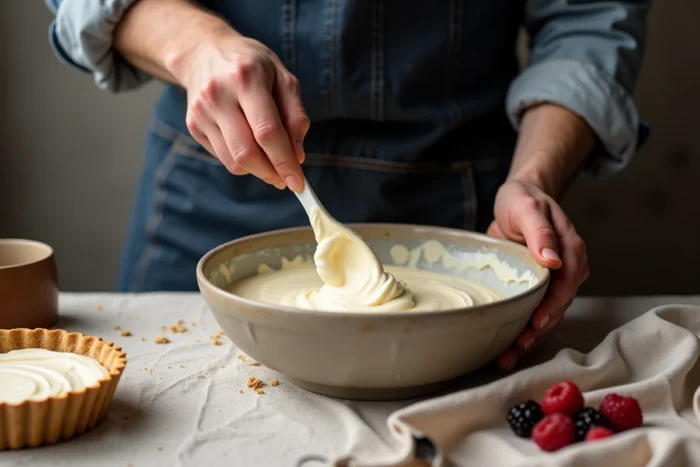
Substituting crème fraîche for mascarpone: when it works and when it fails
Direct substitution between the two is possible in many recipes, but it always alters the result. Replacing crème fraîche with mascarpone in a sauce increases richness and removes acidity. Replacing mascarpone with thick crème fraîche in a tiramisu yields a lighter, less stable result with an acidic note.
- In hot sauce, substitution works both ways if the cooking is short
- In cold pastry (tiramisu, no-bake cheesecake), mascarpone has no direct equivalent in crème fraîche
- For whipped cream, pure substitution does not work: mascarpone alone does not whip up, it must be combined with liquid cream
- In gratins or quiches, liquid crème fraîche remains preferable for its ability to mix evenly with a liquid mixture
The final choice depends on three parameters: the desired fat content, the sought acidic or neutral profile, and the mechanical stability required for the dish. Keeping both in your refrigerator remains the most flexible solution to cover all these situations.