
Tansy (Tanacetum vulgare) multiplies with an ease that poses as many problems as it solves. Spreading rhizomes, abundant spontaneous seeding, and rapid regrowth after division: each method of multiplying tansy requires less horticultural skill than strict confinement. Here, we address the technical points that condition success, beyond the basic advice found everywhere.
Spreading rhizomes of tansy: mastering underground propagation
Vegetative multiplication by rhizomes is the main mode of expansion for Tanacetum vulgare. The underground network progresses laterally several dozen centimeters per season, with each node capable of producing a new aerial stem.
To multiply tansy in a controlled manner, we recommend taking segments of rhizome with at least two visible buds. A segment that is too short, with only one bud, establishes less well in fresh soil. The collection is ideally done at the end of winter, when the plant is still dormant and reserves are concentrated in the underground tissues.
Each segment of rhizome should be planted at a shallow depth, between three and five centimeters below the surface. Planting deeper delays emergence without improving rooting. In clay soil, this reduced depth also prevents root asphyxiation in spring, when the heavy soil remains saturated with water.
Tansy colonizes well beyond the initial planting area through its rhizomes. Without a buried anti-rhizome barrier at least 30 centimeters deep, the plant eventually invades adjacent plots. A simple garden border is not sufficient.
We use rigid recycled polypropylene sheets, driven vertically, to contain the expansion. The techniques for multiplying tansy deserve further exploration, and you can learn more on Les Défricheurs, which detail these practical aspects.
Tansy clump division: timing and cutting technique
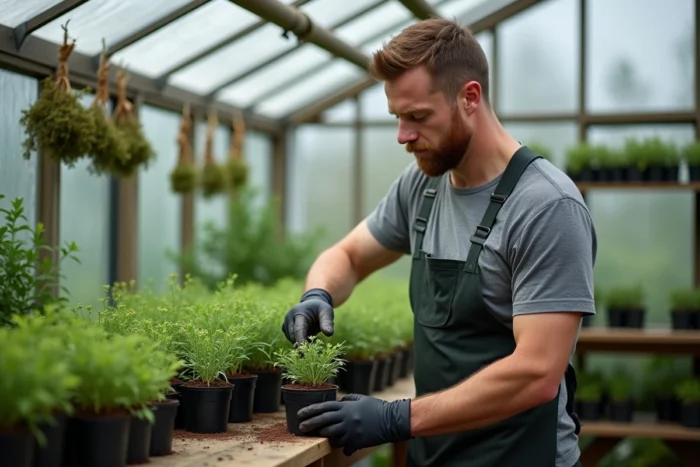
Clump division remains the fastest method to obtain vigorous plants from the first season. It is practiced on mother plants established for at least two years, whose center begins to thin out.
The technical gesture that makes the difference: do not uproot the entire clump to then divide it. We prefer to slice directly into the soil with a well-sharpened spade, isolating a peripheral portion of the clump. The active roots and young rhizomes are found at the edges, not in the center. Taking a central, lignified, and depleted portion yields a plant that takes several weeks to restart.
Adapting division to soil type
In sandy or loamy soil, division is possible from early autumn until the end of winter. Recovery is rapid due to natural drainage. In clay soil, we postpone the operation until the end of winter, once the soil begins to dry out. Dividing in autumn on heavy soil exposes the divisions to excess winter moisture, which promotes rhizome rot.
After division, each division must be replanted immediately. Tansy does not tolerate the drying out of its fine roots well. If a delay is unavoidable, we wrap the divisions in damp newspaper, never in a closed plastic bag that would cause condensation and mold.
Tansy seeding: removing barriers to germination
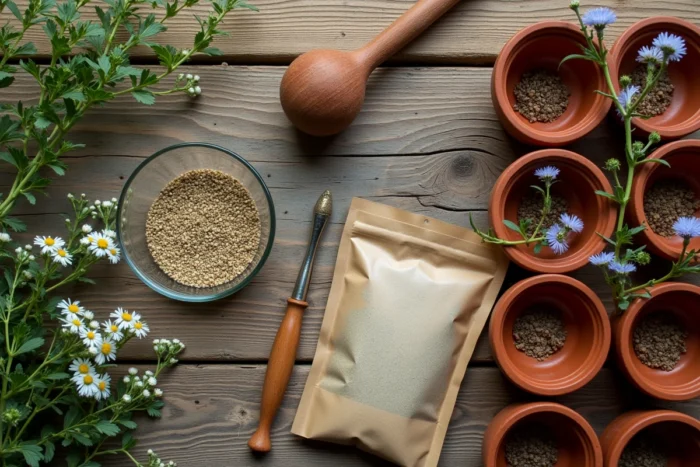
Tansy seeds are extremely fine, almost powdery. Surface sowing without covering is the rule, as the seed needs light to germinate. Burying the seeds, even slightly, drastically reduces the germination rate.
Cold stratification is not mandatory, but it significantly improves the regularity of germination. We place the seeds mixed with damp sand in a bag in the refrigerator for three to four weeks before spring sowing. Without this step, germination can take several weeks, complicating the management of the pots.
- Sowing substrate: fine potting soil mixed in equal parts with river sand, to avoid surface crusting and the risk of seed damping off
- Germination temperature: maintain the tray between 15 and 20 degrees. Above this, the seedlings stretch and become fragile
- Watering: only by capillarity (water tray under the pots), never by direct spraying which displaces the seeds on the surface
- Transplanting: at the stage of four true leaves, not before. Younger seedlings do not handle root disturbance well
Sowing remains slower than division or rhizome collection. Expect a full season before obtaining a plant comparable to what a replanted clump division yields in spring. Its main interest lies in producing a large number of plants at a lower cost, or in obtaining genetically varied subjects.
Multiplying tansy near natural areas: precautions to take
Tansy is now monitored in certain natural environments due to its ability to colonize meadows and wastelands to the detriment of local flora. Several recently published guides on managing spontaneous flora discourage its voluntary multiplication near Natura 2000 areas.
This point changes the approach to multiplication in the garden. If your land borders a natural meadow, a communal embankment, or a rural path lined with spontaneous vegetation, rhizome propagation can cross the boundaries of your plot in just a few seasons. Seeds, dispersed by the wind, pose the same problem on a larger scale.
- Prefer growing in pots or buried containers when the garden is close to sensitive natural areas
- Systematically cut inflorescences before seed formation to limit wind dispersal
- Check with the municipality or natural area manager if there are local recommendations regarding the planting of tansy
Thus, the multiplication of tansy is not limited to a gardening gesture. The choice of method depends as much on the environmental context as on the soil or the calendar. A garden in a suburban area surrounded by mowed lawns does not pose the same risks as a plot on the edge of a wood. Adapting the technique to the location is what separates successful multiplication from a botanical neighbor problem.