Organizing a birthday, a wedding, or a family gathering near Paris involves making decisions between several parameters that are rarely presented together: capacity, outdoor space, flexibility of the caterer, and noise constraints. This article compares the criteria that truly differentiate private event venues in Île-de-France, based on available data for estates and halls accessible from the capital.
Noise constraints and contractual clauses for a private event
The choice of a reception venue is not limited to decor. One parameter often absent from commercial brochures concerns outdoor noise management. According to Kohen Avocats (September 2026), the duration, repetition, and intensity of noise can characterize an abnormal disturbance of the neighborhood, even in an estate far from Paris.
The framework established by the 2017 decree sets limits on sound levels and obligations towards the neighborhood. In September 2026, professionals in the event sector were calling for an adaptation of this regulation for festivals and outdoor events.
Before signing, three points deserve verification in the contract:
- The end time for amplified music, which varies according to municipalities and local prefectural orders
- Possible restrictions on outdoor sound systems (maximum power, speaker orientation)
- The liability clause in case of complaints from the neighborhood, which may fall on the organizer or the venue owner
An estate in the heart of nature with several hectares of parkland offers a wider acoustic margin than a hall in the city center. For festive events with late music, this criterion weighs as heavily as the capacity.
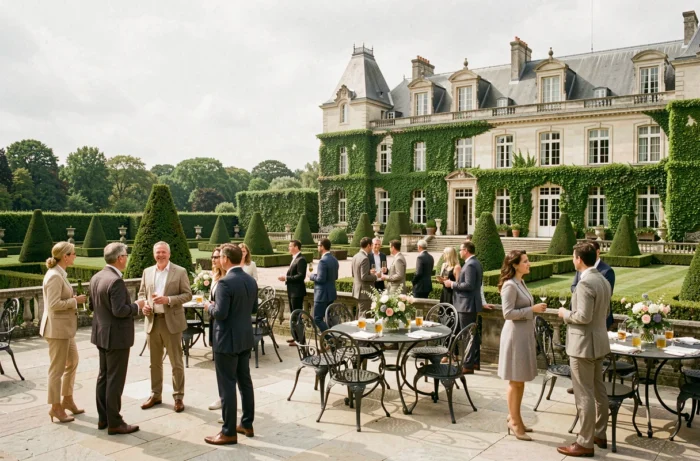
Venues located in Seine-et-Marne, Essonne, or Yvelines offer wooded environments where the distance from homes reduces the risk of conflict. An estate listed on les-jardins-de-camille.fr illustrates this type of configuration, with a natural setting designed for private receptions near the capital.
Capacity, space, and caterer: comparative table of venues near Paris
The differences between reception venues in Île-de-France are significant. Here is a comparison based on accessible data for several sites.
| Venue | Distance from Paris | Cocktail capacity | Indoor area | Outdoor area | Caterer |
|---|---|---|---|---|---|
| Chalet des Îles (Bois de Boulogne) | In Paris | 800 people | 430 m² | 861 m² | Mandatory |
| Pavillon de Jardy (Marnes-la-Coquette) | About 15 min | 1,200 people | 1,200 m² | 700 m² (terrace) | Free or turnkey |
The Chalet des Îles, accessible only by boat, requires its caterer. The Pavillon de Jardy, adjacent to an equestrian center, offers the choice between self-catering or turnkey service. This parameter radically changes the final budget.
A mandatory caterer simplifies organization but removes any room for negotiation on the price per guest. Conversely, managing the caterer freely allows for choosing a provider suited to the desired type of cuisine, the dietary needs of guests, or the available budget.
Why outdoor space matters as much as capacity
For a summer event, outdoor space determines the actual comfort of guests. A cocktail capacity of 800 people in 861 m² of outdoor space gives about 1 m² per person, which corresponds to a high density. The Pavillon de Jardy, with 700 m² of terrace but also access to a park of several dozen hectares, offers a different breathing space.
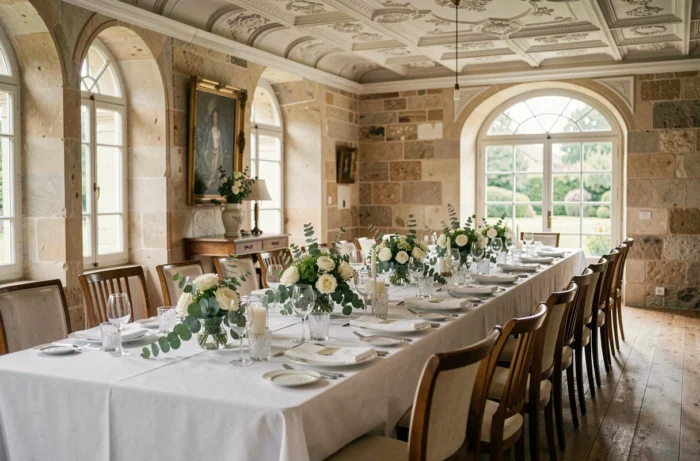
Country estates close to Paris (Seine-et-Marne, Yvelines, Essonne) generally offer parks of several hectares, private forests, or landscaped gardens. For a wedding of 150 people, the difference between a 500 m² space and an estate with a park is noticeable from the aperitif.

Accessibility for people with reduced mobility: a criterion to check before booking
Commercial brochures often mention “accessible for people with reduced mobility” without detailing the actual route. According to the press release from the National Conference on Disability 2026 (published on September 4, 2026), train stations in Île-de-France continue to be gradually made accessible, but routes involving old buildings or paved pathways remain problematic.
For a castle or a character house, the mention “accessible” may mean that a ramp exists at the main entrance, without the restrooms, reception room, or garden being wheelchair accessible. A detailed accessibility plan for people with reduced mobility should be requested before any booking.
Points to check concretely:
- Width of doors and absence of steps between reception areas
- Accessibility of restrooms (and not just their existence on the ground floor)
- Practicability of the path between the parking lot and the venue entrance, especially on sloped or gravel terrain
- Presence of an elevator if the reception is on an upper floor
A recently renovated estate is more likely to meet current standards than a classified castle whose adaptation works are constrained by heritage rules.
Self-management or turnkey: how the format changes the budget
The choice between a self-managed venue and an all-inclusive package is not just a question of comfort. It changes the structure of the budget.
In self-management, the organizer chooses each provider: caterer, decorator, DJ, photographer. This allows for adjusting expenses item by item. However, coordination relies entirely on the host or an external wedding planner.
In a turnkey package, the venue provides a package including catering, furniture, and sometimes entertainment. The overall cost is often more predictable but less negotiable. For a large-scale event, the difference can represent a significant portion of the total budget.
Country houses in Île-de-France with integrated accommodations add an additional variable. Having rooms on-site avoids transportation and accommodation costs for guests coming from afar, while extending the conviviality of the stay in the heart of a park or forest.
The final filter to apply remains the detailed quote. A venue advertised at an attractive price may hide additional costs: cleaning fees, security deposit, rental of additional furniture, mandatory insurance. Requesting a line-by-line quote before any visit avoids unpleasant surprises and allows for a reliable comparison between two competing estates.