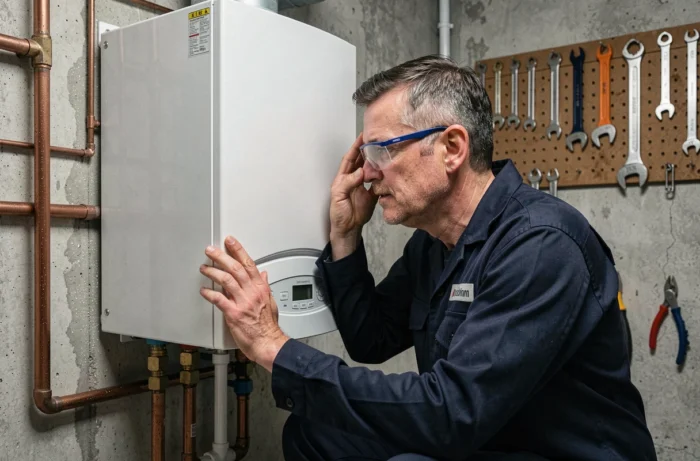
A sharp click that returns every morning at startup, a high-pitched whistle when you turn on the hot water tap, a dull humming at night: we all tend to turn up the TV volume and forget. The problem is that some of these sounds signal a part about to fail, while others are simply part of the normal operation of the device. Distinguishing between the two avoids unnecessary intervention or, conversely, a breakdown in the middle of winter.
When a boiler noise hides a flue or ventilation problem
We rarely think about ventilation when the boiler starts making noise. Yet it is one of the most underestimated causes, especially after insulation work or window replacement. By improving the airtightness of the home, we inadvertently reduce the intake of fresh air that the gas boiler needs to burn fuel properly.
The concrete result: the flame becomes unstable, and the device produces clicks or rumblings with each combustion cycle. If you also perceive unusual boiler noises accompanied by headaches or nausea, you must turn off the device, open the windows, and leave the premises before taking any further action.
A noise after insulation work should lead to a flue check, not just a mechanical diagnosis. The heating engineer will check that the flue and combustion air intake are suitable for the new configuration of the home. This is a point that most online guides do not address, even though it directly concerns safety.
Circuit pressure and circulator: the two most common noise sources
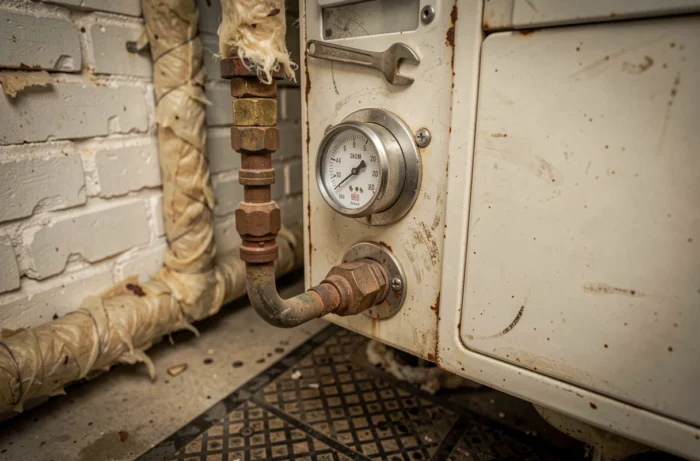
When intervening on-site, the two culprits constantly arise: a worn circulator and improperly adjusted circuit pressure. The circulator is the pump that circulates water in the central heating system. When its bearings wear out, it emits a continuous hum that gradually intensifies.
A simple test can confirm the diagnosis. You turn off the circulator for a few seconds via the boiler’s control panel. If the noise disappears immediately, the pump is at fault. If the sound persists, you look elsewhere.
Circuit pressure is the other classic issue. In most domestic installations, the pressure gauge should be within a specific range indicated by the manufacturer. Too low pressure encourages gurgling (air trapped in the radiators), while too high pressure can cause whistling at the safety valve.
- Gurgling in the radiators: bleed each radiator starting from the one farthest from the boiler, then restore the pressure to the recommended level.
- High-pitched whistling near the boiler: check that the safety valve is not leaking and inspect the expansion vessel, as a punctured membrane raises the pressure with each heating cycle.
- Continuous humming: inspect the circulator, ensuring it is not blocked by sludge and that its rotation speed meets the network’s needs.
These operations remain accessible for a savvy DIYer, except for replacing the circulator or the expansion vessel, which requires partially draining the circuit.
Limescale and sludge in the exchanger: the kettle noise
It is often referred to as the “kettle noise” or kettling in English. It is a dull rumble, sometimes accompanied by clicks, that mainly occurs when the boiler heats up. The cause is almost always the same: limescale or sludge accumulated in the heat exchanger.
Limescale reduces the cross-section for water flow. Water that remains in prolonged contact with the heating surface overheats locally, forming micro-bubbles of steam that implode, producing this characteristic noise. The older the installation and the harder the water, the worse the phenomenon becomes.

A sludge removal followed by a cleaning of the exchanger resolves the issue in the vast majority of cases. The heating engineer uses a rinsing product injected into the circuit, followed by a sludge removal pump to evacuate the particles. On a standard wall-mounted gas boiler, the operation usually takes half a day.
Feedback varies on this point, but some installers recommend installing a magnetic filter (sludge pot) at the boiler outlet to continuously capture metallic residues. This filter does not eliminate limescale but significantly limits the formation of black sludge in steel or cast iron circuits.
Annual maintenance and flue cleaning: two obligations, two distinct checks
Many homeowners think that annual maintenance covers the entire installation. In reality, boiler maintenance and flue cleaning are two separate obligations. Maintenance concerns boilers with a power between 4 and 400 kW, in accordance with the Environmental Code and decree n° 2023-641 of July 20, 2023. Flue cleaning, on the other hand, follows rules that may vary according to local regulations.
This distinction matters when searching for the source of a noise. Maintenance may reveal a clogged burner or a failing circulator. Flue cleaning, however, will detect a partially obstructed flue that disrupts the draft and generates vibrations or rumblings.
- Annual maintenance includes cleaning the burner, checking combustion, and measuring emissions, including carbon monoxide.
- Flue cleaning pertains to the smoke evacuation flue and may be required once or twice a year depending on the municipality and type of fuel (gas, wood, oil).
- The maintenance certificate is distinct from the flue cleaning certificate: the insurer may require both in the event of a claim.
A often overlooked safety point: the carbon monoxide detector is not mandatory in France, unlike the smoke detector. If the boiler produces an abnormal noise associated with an unusual smell or physical symptoms (headaches, dizziness), you must react as if facing a gas leak: turn off, ventilate, evacuate, call for help. The mechanical diagnosis comes afterward.
Identifying a boiler noise ultimately involves crossing three parameters: the type of sound, when it occurs, and the recent history of the installation (work, bleeding, maintenance). A click at startup does not carry the same severity as a continuous whistling under pressure. Keeping these markers in mind allows you to give the heating engineer a precise description, which speeds up the diagnosis and reduces the cost of the intervention.