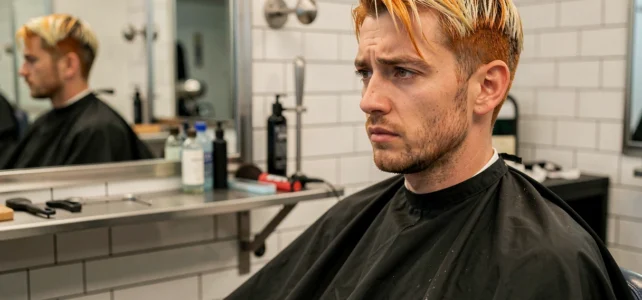
A blonde that turns orange on short men’s hair poses a different technical problem than that encountered on women’s longer lengths. The short length of the cut leaves little room for maneuver, and the density of men’s hair (often thicker in cross-section) reacts differently to bleaching. Correcting failed blonde highlights on men requires a precise diagnosis before any intervention, or else it risks worsening breakage or demarcations.
Pre-pigmentation before correction: the step that most men skip
A bleached hair that is too light or has turned straw yellow is hair that has been stripped of its natural pigments. Directly applying a darker color over it almost always results in a dull, greenish, or khaki outcome.
The technical solution involves pre-pigmentation with an appropriate warm base. We recommend applying a light copper or golden pigment to the over-lightened areas before the target color. This filling reconstructs the missing bleaching base and allows the final color to adhere properly.
On short men’s hair (3 to 8 cm), this operation takes about ten minutes. The filling pigment is chosen based on the starting level: an orange base to move towards a medium brown, a golden base to aim for a natural dark blonde. Without this step, the result will be dull from the first shampoo.
To delve deeper into the topic of correction, the hair tips on Annuaire Beauté detail several correction scenarios suitable for short cuts.
Targeted correction by zones versus global recoloring
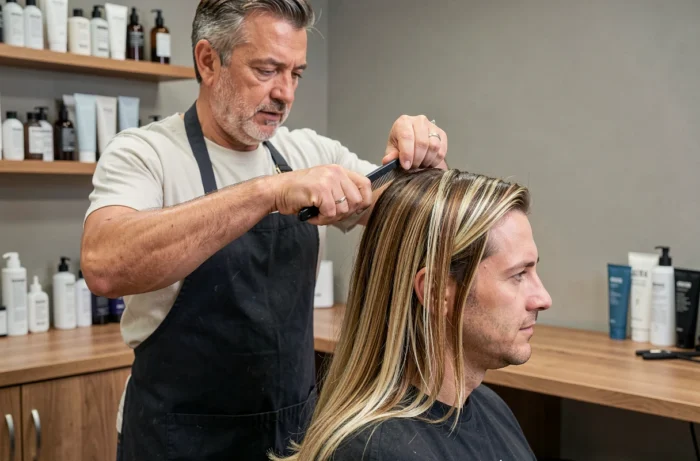
The most common mistake after failed highlights is to cover the entire head of hair with a permanent color. On short hair, this approach creates an unnatural flat uniformity and unnecessarily overloads areas that had no issues.
Working section by section reduces the risk of worsening demarcations. The principle: isolate each problematic area (too light strands, overly contrasting roots, localized orange reflections) and apply an appropriate corrective only where necessary.
Localized yellow or orange reflections
A toner or low-oxidation glaze neutralizes unwanted reflections without affecting the hair structure. On a yellow base, an ash violet toner is sufficient. On a copper or orange base, a blue corrector is more effective. The processing time varies according to the intensity of the reflection, but exceeding the recommended time can turn it gray, especially on fine hair.
Visible demarcations between highlights and natural base
Sharp demarcations are a sign of poorly blended highlighting techniques. We observe that on short men’s cuts, the zebra effect is even more visible than on longer lengths because the contrast stands out over just a few centimeters.
The correction involves a slight blending with a brush on the demarcation lines, using a mix of the base color and an intermediate tone. A semi-permanent gloss can also soften the transition without heavy chemical commitment.
Assessing the condition of the fiber before any chemical retouch
No correction should be attempted on hair whose fiber is compromised. Signs to check for include:
- The wet hair stretches abnormally and does not return to its original shape, indicating a loss of elasticity due to the destruction of disulfide bonds
- Sharp breakage appears during brushing or when running fingers through, indicating a bleaching that has attacked the cortex deeply
- The scalp shows redness, burning sensations, or scabs, which formally contraindicates any new chemical application
- The hair has a rubbery texture characteristic of excessive alkaline treatment
In these cases, the top priority is repair. A protein mask (keratin or silk proteins) applied once or twice a week for a minimum of two to three weeks helps to reconsolidate the fiber before considering a color correction.
Toner, gloss, or semi-permanent color: choosing the right correction tool
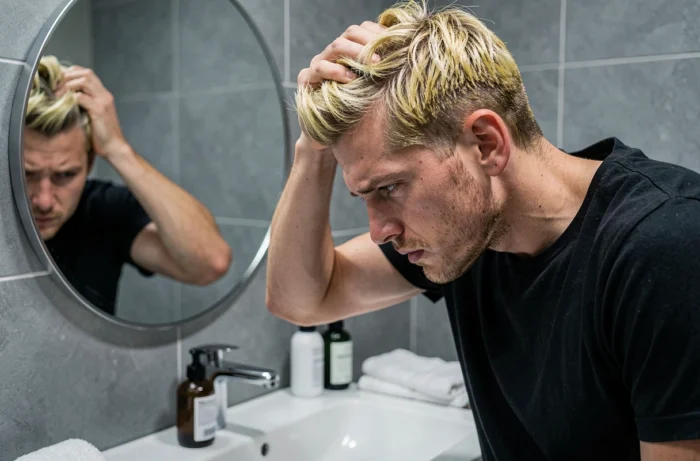
Each type of correction corresponds to a level of severity of the mistake. Do not over-correct with a permanent color when a toner is sufficient is the basic rule in salon corrections.
- The toner (glaze) is suitable when the level of lightening is correct but the tone deviates (too yellow, too warm). It deposits on the surface, fades in a few shampoos, and does not further damage the fiber
- The gloss adds shine and light tone correction. It works well on slightly too light highlights that you want to warm up or cool down by half a tone without commitment
- Semi-permanent color is indicated when you need to go up one or two tones. It contains no ammonia and fades gradually, which limits the risk of a marked root effect on regrowth
Permanent color should only be used as a last resort, when the problem is structural (excessive bleaching on more than half of the hair, need to return to the natural color). And in this case, the pre-pigmentation described above remains essential.
Post-correction care for bleached hair in men
Chemical correction, even gentle, weakens hair that is already sensitized. Short men’s hair dries quickly in the open air, which sometimes masks its actual porosity. Porous hair absorbs toner unevenly and loses its correction more quickly.
A sulfate-free shampoo limits premature stripping of the glaze or toner. Spacing shampoos to every other day significantly prolongs the hold of the correction on short hair.
The weekly repairing mask is not optional after a retouch. Formulations based on keratin or argan oil reconstruct the lipid sheath of the hair and limit the straw-like effect that betrays poorly cared for corrections.
A often overlooked point: the heat from the hairdryer opens the cuticles and accelerates the washing out of the corrected color. On short hair, natural drying takes a few minutes and preserves the correction much longer than daily blow-drying.