A swimming pool water that remains green despite repeated additions of chlorine poses a measurable problem: the level of cyanuric acid (stabilizer) in the pool. This compound, present in most stabilized chlorine tablets, accumulates over the seasons without ever degrading naturally. Clarifying saturated pool water first requires understanding what blocks the disinfecting power of chlorine, then choosing the method suited to the saturation level.
Stabilizer threshold and chlorine effectiveness: key points to know
The stabilizer (isocyanuric acid) protects chlorine from degradation by UV rays. Its gradual accumulation eventually neutralizes the disinfecting action of chlorine, making each addition of product almost useless.
The threshold of 75 mg/L of cyanuric acid is used as a health reference for public pools in France. This ceiling now serves as a recommended alert threshold for private pool owners: above this level, it is advised to plan a partial drain rather than increase chlorine doses.
| Stabilizer level (ppm) | Chlorine effectiveness | Recommended action |
|---|---|---|
| Below 30 | Poorly protected chlorine from UV, quick consumption | Add stabilizer or use stabilized chlorine |
| 30 to 50 | Suitable zone, active and protected chlorine | Maintain balance, monthly check |
| 50 to 75 | Partially hindered chlorine | Monitor, consider adding fresh water |
| Above 75 | Almost inactive chlorine despite measurable level | Partial drain necessary |
This table summarizes why a “normal” chlorine level on a test strip can coexist with green or cloudy water. Chlorine is present but blocked by excess stabilizer.
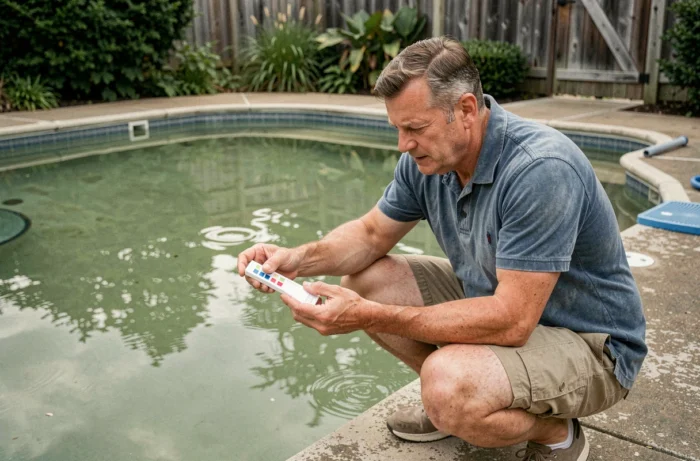
Before investing in additional shock treatment, the first step is to measure the stabilizer level using appropriate test strips (such as Aquacheck 7) or a photometer at a professional’s. Trying to clarify the pool water without knowing this parameter is like treating a symptom without identifying the cause.
Partial drain of the pool: the only method that reduces stabilizer
No commercial chemical product destroys cyanuric acid once dissolved in water. This is a feature often overlooked: the stabilizer does not degrade or evaporate. The only way to lower its concentration is to renew part of the pool water.
The proportion to drain depends on the measured level. For a pool whose stabilizer significantly exceeds the alert threshold, draining half the volume is often necessary. A level just above the suitable zone can be corrected by renewing about one-third.
Precautions during draining
- Never completely empty an inground pool: the pressure from the ground can lift or crack the structure, especially on clay soil or in the presence of a water table
- Discharge chlorinated water into the sewage system (sewer) and not directly into the garden or a watercourse, where residual chlorine can affect vegetation and wildlife
- Gradually fill with fresh water, then rebalance the pH before any addition of chlorine so that the treatment is immediately effective
After filling, a new stabilizer test confirms that the level has dropped below 50 ppm. It is only at this stage that shock treatment becomes relevant.
Shock treatment and filtration after water renewal
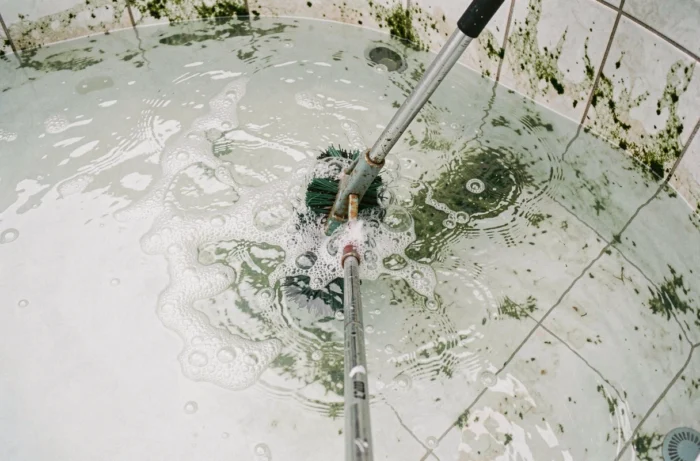
Once the stabilizer is brought back into the suitable zone, chlorine regains its disinfecting power. The shock treatment can then eliminate the algae and microorganisms that proliferated during the saturation period.
Two options stand out for shock chlorine:
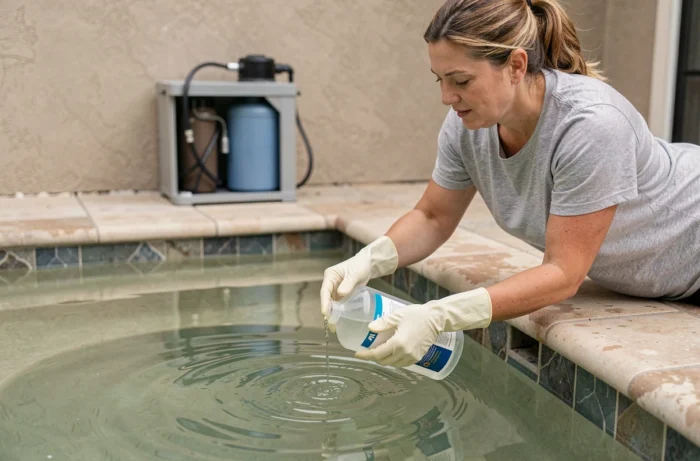
- Calcium hypochlorite (unstabilized shock chlorine): it does not add any additional stabilizer to the water, which prevents recreating the problem. This is the coherent choice after a partial drain
- Dichlor or trichlor stabilized: less suitable in this context, as it reintroduces cyanuric acid with each use
- Bleach (sodium hypochlorite): used by some individuals as a cost-effective alternative to shock chlorine, it also does not contain stabilizer
Filtration must run continuously for at least 24 to 48 hours after the shock treatment. A backwash of the filter before and after the shock significantly improves the result, as a filter clogged with algae cannot clarify the water.
Adding a flocculant after the shock accelerates clarification by agglomerating fine suspended particles. The flocculant then settles at the bottom of the pool, where it can be vacuumed to the drain (in the “drain” position of the multiport valve) without passing through the filter again.
High-temperature pool water: why saturation accelerates in summer
Contents addressing saturated water rarely discuss the impact of temperature. Water at 30 °C can turn green in just a few hours if free chlorine is insufficient. Heat promotes algae proliferation and accelerates chlorine consumption, leading to increased additions of stabilized tablets.
This vicious circle explains why saturation problems mainly occur in the middle of summer, precisely when the pool is most used. Increased attendance brings organic matter (sweat, sunscreen) that consumes even more chlorine.
Limiting stabilizer accumulation over time
Switching to a treatment system without stabilizer (salt electrolyzer, liquid chlorine, UV) eliminates the source of accumulation. For those who continue to use chlorine tablets, alternating with unstabilized chlorine every other week significantly slows the rise of cyanuric acid levels.
Monitoring the stabilizer every four to six weeks during the swimming season allows for detecting drift before the water becomes cloudy. Waiting for algae to appear means that the critical threshold has already been exceeded for several weeks, and that a partial drain becomes the only realistic solution.