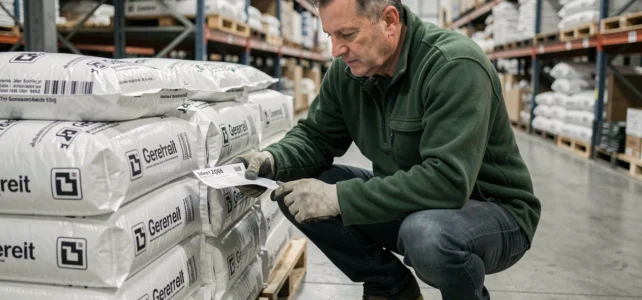
The French wood pellet market has been experiencing a phase of relative stability for several months, but signals for autumn 2026 indicate a shift. In this context, major retailers like E.Leclerc remain a benchmark for households that heat with pellets. The prices displayed in stores vary by region, pellet brand, and purchase format, making comparison less straightforward than it seems.
Price Increase Expected in September 2026: What Market Data Indicates
The advice to buy off-season comes up every year, but the situation for autumn 2026 deserves a more precise examination based on recent data.
According to trends observed in the European market and reported by specialized sites like Pelleteco, a gradual price increase is anticipated starting in September 2026. Prices per ton on pallets could exceed 450 euros at the start of the school year if demand follows the usual pre-season pattern.
This projection is based on a classic mechanism: the replenishment of stocks by distributors in the second half of the year drives up purchase prices from manufacturers, and this pressure is reflected in the final store price. This phenomenon is nothing new, but it takes on a particular dimension in 2026 because the French wood industry is facing rising logistical costs, particularly related to the consequences of recent wildfires on supply.
To track the evolution of the price of Leclerc pellets 2026, it is useful to monitor prices starting in July, when the first seasonal deliveries arrive at warehouses.
Price per Kilo at Leclerc: The Only Reliable Indicator for Comparison
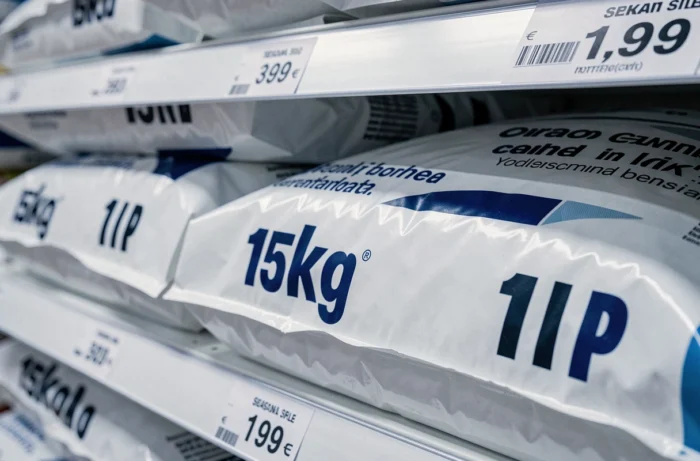
The prices recorded in available sources place the 15 kg bag at E.Leclerc in a range from about 3.50 euros to just under 6 euros. This gap may be surprising, but it can be explained by several compounding factors.
The price per kilo remains the only relevant benchmark for comparing two offers. A bag priced attractively but packaged in 10 kg may end up being more expensive per kilo than a 15 kg bag sold for a few cents more.
Factors Causing Price Variation from Store to Store
- The certification of the pellet (DINplus, NF Biocombustibles) directly influences production costs and thus the price on the shelf. A DINplus certified pellet limits stove fouling, justifying a higher purchase cost.
- The geographical location of the store affects transportation costs from the manufacturing plant. A Leclerc located near a sawmill or granulation site will often display a lower price.
- Occasional promotional operations, varying from one store to another, can significantly lower the unit price, sometimes below 4 euros for the 15 kg bag.
However, the available data does not allow for a conclusion that one format (bag or pallet) is systematically more advantageous. Some field reports indicate that the pallet is not always cheaper per kilo than the individual bag, especially when delivery fees are included in the pallet price but not in the bag price.
Declining MaPrimeRénov’ Aids: A Parameter Overlooked in Heating Cost Calculations
Content discussing the price of Leclerc pellets isolates this price from the rest of the economic equation. The actual cost of heating with pellets is not limited to the price of the fuel.
The Propellet association indicates that MaPrimeRénov’ aids for pellet systems have undergone two successive reductions, the first in 2024, the second during a subsequent adjustment. This double reduction alters the calculation for households considering installing a pellet stove or boiler.
A household that would have benefited from significant aid two years ago must now account for a much higher out-of-pocket cost. The price of the pellet bag, even if competitive at Leclerc, does not alone offset this initial equipment cost.
Profitability of Pellets Compared to Other Energy Sources
Wood pellets maintain a price advantage over electricity in terms of cost per kilowatt-hour produced. Available data in comparisons place pellets around 7 to 8 cents per kWh, compared to about 20 cents for electricity at regulated rates.
This difference remains significant for primary heating use. Conversely, for a supplementary stove used a few weeks a year, the savings on fuel do not always justify the investment in a dedicated appliance, especially with declining aids.
Pellet Storage: The Invisible Factor Affecting Efficiency
A poorly stored bag of pellets loses its calorific power even before being poured into the stove’s reservoir. Moisture is the main enemy of pellets, and this point is rarely quantified by buyers.
A pellet that absorbs ambient moisture partially disintegrates, produces more ash, and delivers less heat per kilo. The price per kilo displayed in stores only reflects the actual cost if the storage preserves the quality of the fuel.
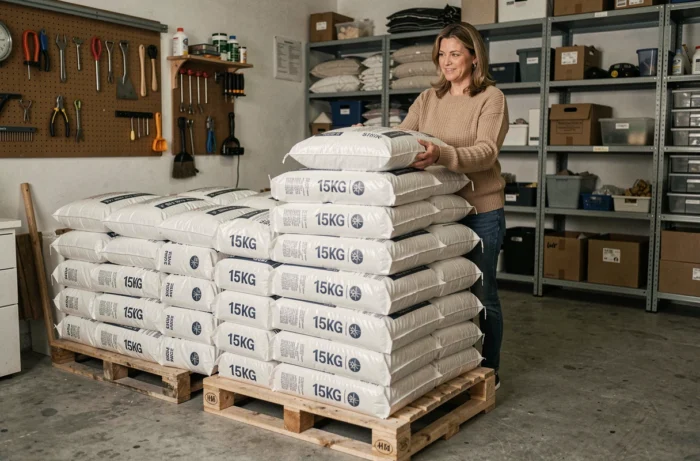
- Store bags in a dry location, protected from temperature variations, ideally elevated on a wooden pallet to avoid contact with potentially damp ground.
- Use the oldest bags first to prevent gradual degradation of the pellets at the bottom of the stock.
- Check the integrity of the packaging upon delivery: a punctured or torn bag allows moisture to enter right from transport.
Well-stored pellets retain their full calorific power, which means paying less for each kilowatt-hour produced. Conversely, negligent storage can negate the savings achieved by buying at the best price at Leclerc or elsewhere.
The price of the pellet bag at Leclerc in 2026 is within the average of the French market, with sometimes marked local variations. The most favorable buying window remains spring and early summer, before the expected price increase in September.