We open the roller shutter, take a look at the pool, and the water pulls on a milky green hue. The classic reflex would be to drain a good part of the volume to start fresh. However, since the drought orders have been implemented in most French departments, draining or filling one’s pool freely exposes one to a fine of up to 1,500 euros, or even 3,000 euros in case of repeat offenses.
Therefore, we must achieve crystal-clear water without this safety net, working solely on the chemistry and filtration of the existing volume.
Recovering cloudy water without draining: the drought constraint changes the game
When filling is restricted to the bare minimum (compensation for evaporation), every liter counts. We can no longer afford a too generous backwash of the filter or switching to drain mode to evacuate a bottom laden with particles. The strategy relies on a simple principle: treat and filter the water in a closed circuit, without wasting volume.
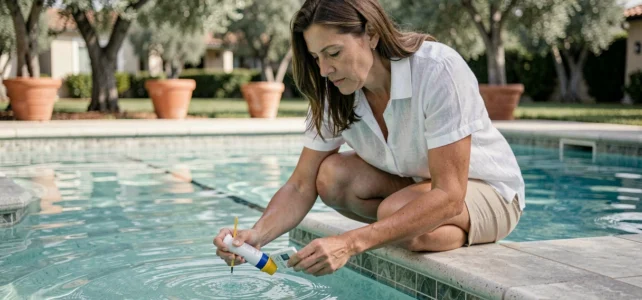
Specifically, we start by measuring the pH. Milky or whitish water almost always indicates an acid-base imbalance, often a pH that has risen above 7.6 after a storm or heatwave. As long as the pH is not brought back between 7.0 and 7.4, no treatment product works properly. Chlorine loses a large part of its disinfecting power above 7.8, and the flocculant poorly agglomerates suspended particles.
When looking for tips for a clear water pool, this pH step is often the one that is rushed, even though it conditions everything else.
Continuous pool filtration: duration, pressure, and controlled backwashing
The filter is the true engine of recovery. Whether it’s a sand, cartridge, or diatomaceous filter, its role is to capture fine particles responsible for the cloudy appearance. During the recovery period, filtration must run continuously, 24 hours a day, until the water becomes clear again. Turning off the pump at night to save energy only prolongs the problem by several days.
Monitor the sand filter pressure gauge
The pressure gauge indicates the internal pressure of the filter. When it exceeds the normal operating pressure by 0.3 to 0.5 bar, the filter media is clogged. A backwash is then performed, but its duration should be limited to avoid draining too much water. Two to three minutes is sufficient in most cases.
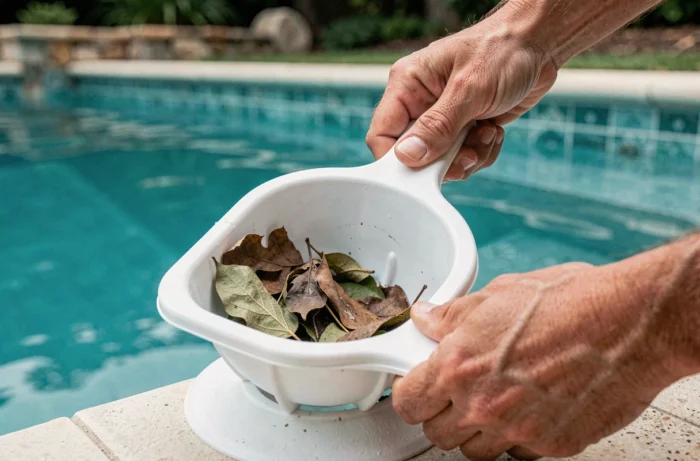
For a cartridge filter, rinse the cartridge with a gentle jet. If it is worn or deformed, no chemical treatment will compensate for a failing mechanical filtration. Opinions vary on this point, but replacing a cartridge at the end of its life remains the most effective action to achieve clear water.
Shock chlorine and flocculant: in what order to treat pool water
A common mistake is to pour clarifier or flocculant into water with insufficient chlorine levels. Microscopic algae then continue to multiply faster than the flocculant can agglomerate them. The effective sequence follows a precise order:
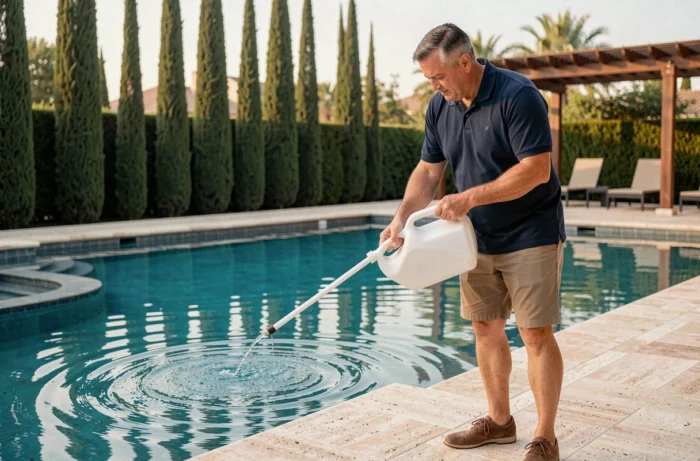
- Adjust the pH between 7.0 and 7.4 with a pH minus corrector, testing again after two hours of circulation by the pump.
- Perform a shock chlorine treatment (preferably unstabilized chlorine) at the end of the day, when UV rays no longer degrade the active molecule. Let the filtration run all night.
- The next day, if the water is still cloudy but the chlorine level has returned to the normal range, add a liquid flocculant compatible with the type of filter. Tablet or sock flocculants are reserved for sand filters, not cartridges.
- Brush the walls and bottom to detach the biofilm and deposits so that the flocculant can capture these suspended particles.
If after 48 hours of continuous filtration the water remains cloudy, check the stabilizer level (cyanuric acid). An excess of stabilizer blocks the action of chlorine even when the measured value seems correct on the test strip. In this case, the only solution is to renew part of the water, which complicates the situation during restrictions.
Green water and algae: identify the type of greening before acting
Transparent green water and opaque green water are treated differently. When you can still see the bottom of the pool through a greenish tint, the algae are in the colonization phase. A well-dosed shock chlorine treatment, combined with brushing the walls, is usually enough to reverse the situation within 24 to 48 hours.
Dark green and opaque water indicates advanced proliferation. The algae have formed a biofilm on the surfaces and saturated the water with organic matter. The shock treatment must then be more concentrated, and a curative anti-algae product complements the chlorine to prevent recolonization while the filter evacuates the dead residues.
The trap of masked limestone
In areas where the network water is hard, limestone deposits on the filter media and gradually reduces filtration capacity. The filter seems to operate normally, the pressure remains stable, but fine particles pass through. Descaling the filter at the beginning of the season, with an acid product designed for this purpose, avoids this scenario. This action is rarely mentioned in standard maintenance routines, yet it significantly changes the clarity of the water throughout the season.
Weekly routine to keep a pool with clear water all season
Recovery is always longer and more costly in products than prevention. A simple routine applied each week avoids most episodes of cloudy water:
- Test pH and chlorine levels twice a week during the peak season, once a week outside of heatwaves.
- Clean the skimmer baskets and the pump pre-filter to maintain optimal filtration flow.
- Adjust the filtration time to the water temperature: as a general rule, divide the temperature by two to obtain the number of hours of daily filtration.
- Brush the walls and waterline once a week to prevent biofilm from settling.
Maintaining chemical balance costs less than recovering it. A few minutes of regular testing and adjustment are enough to keep the water clear, even when water restrictions prevent renewing the pool’s volume.