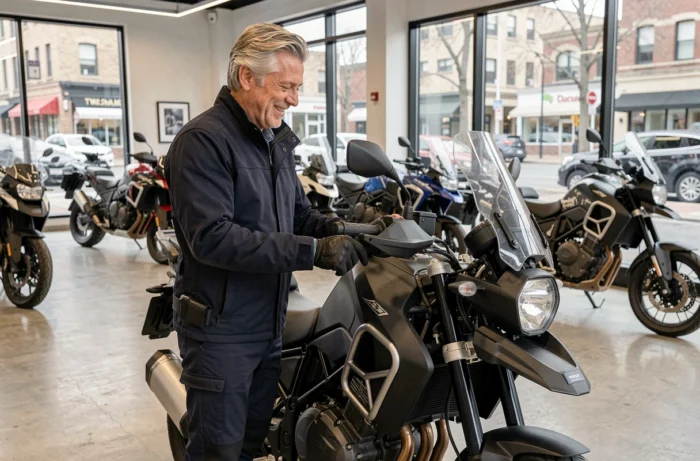
Getting back on a motorcycle or changing bikes after 50 means first dealing with a body that absorbs vibrations, weight at a standstill, and hard braking differently. The choice of a motorcycle after 50 is not just about the technical specifications: it is decided at the first stop on a slope, when placing both feet flat on the ground, or after three hours in the saddle without a break.
Seat height and weight at a standstill: the two criteria that change everything after 50
One can compare horsepower, engine torque, and electronic options. In practice, the first difficulty for a senior rider manifests at zero speed. Maneuvering a heavy motorcycle in a sloped parking lot or lifting it after losing balance at a standstill puts much more strain on the lower back, knees, and shoulders than accelerating on a highway.
The seat height determines the ability to place the feet flat. With age, hip flexibility decreases. A seat above 820 mm complicates building confidence for many average-sized riders. Some popular adventure bikes offer low seats as an option, but the center of gravity remains high, which does not solve the stability issue at low speeds.
Before choosing a model, it’s beneficial to spend time at the dealership not just sitting on the bike on its stand, but taking it out of the display, pushing it for ten meters, and simulating a tight turn with the engine off. That’s when you know if the weight is manageable on a daily basis. A comprehensive guide to suitable models is available on the Ma Future Voiture website, with comparisons focused on comfort and accessibility.
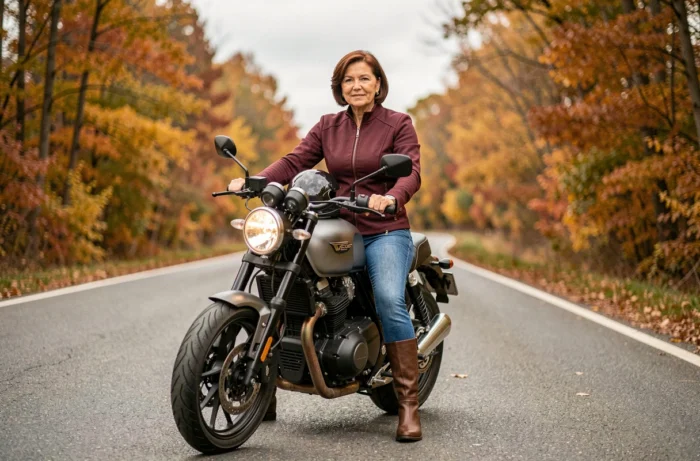
Electronic aids on a senior motorcycle: what really helps on the road
Catalogs are full of acronyms (ABS, TC, IMU, quickshifter). Not all of these aids have the same impact for road use after 50. Two systems deserve particular attention.
Cornering ABS reduces the risk of falling while braking in a turn. Braking reflexes lose precision with age, and a front wheel lock in a curve rarely forgives. On models equipped with an inertial measurement unit (IMU), the system adjusts braking pressure based on the lean angle. This technology can be found on accessible machines like the Honda CB650R or the Yamaha Tracer 7 GT.
Traction control (TC) provides a safety net on wet or gravelly surfaces. Feedback varies on this point depending on the type of mapping offered, but adjustable TC across several levels allows for tailoring the intervention to one’s riding style.
What can be ignored without regret
The quickshifter (gear shifting without clutching) is pleasant but not essential. Semi-active electronic suspensions add comfort but also weight, mechanical complexity, and maintenance costs. For road and touring use, well-tuned conventional suspensions by a professional do the job without inflating the bill.
Roadsters, adventure bikes, and GTs after 50: what type of motorcycle for what use
The choice of motorcycle type affects posture, fatigue, and long-term enjoyment. Three categories stand out for riders over 50.
- Medium displacement roadsters (Honda CB500F, Kawasaki Z650, Suzuki SV650) offer an upright position, manageable weight, and an accessible seat. Their limit: the lack of wind protection beyond 110 km/h, which tires the upper body on the highway.
- Road-oriented adventure bikes (Honda NC750X, Yamaha Tracer 7, BMW F750GS) combine a high position, decent aerodynamic protection, and versatility. The road/comfort compromise is often the best in this category for long trips.
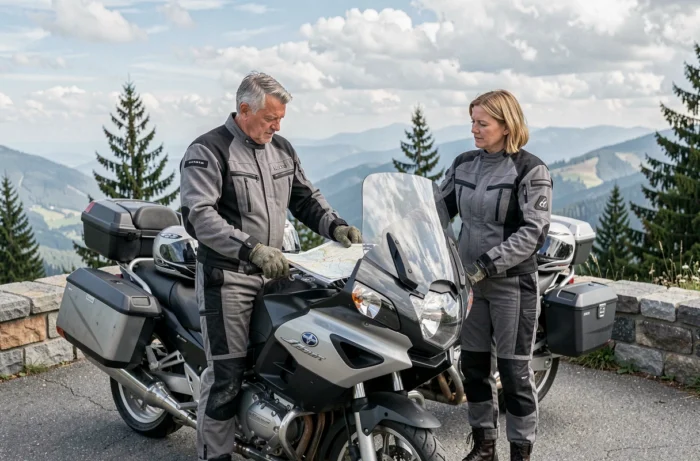
- GTs (BMW R1250RT, Yamaha FJR1300) prioritize pure comfort with wide seats, full protection, and luggage options. The downside: a weight often exceeding 250 kg fully fueled, complicating urban maneuvers.
The choice depends on annual mileage and the type of routes. For two to three-hour weekend rides, a roadster with a small added windscreen is sufficient. For multi-day trips, the road-oriented adventure bike remains the most suitable compromise for the physical constraints related to age.
Used motorcycles after 50: inspection points before purchase
The used market represents a major part of the motorcycle market in France, and it is often the most rational choice for a rider returning after a break or wanting to test a segment without committing to a new model.
On a used motorcycle, the condition of the brakes and forks matters more than the displayed mileage. A model with low kilometers but that has sat for five years in a damp garage may have dry fork seals, warped discs, and an irrecoverable battery. Conversely, a regularly maintained machine with a complete service history remains reliable well beyond 40,000 km.
Priority inspection points
- Play in the steering bearings (turn the handlebars from stop to stop, bike on the center stand, to detect a tight spot).
- Condition of brake pads and discs: visual wear, signs of overheating, residual thickness.
- Tires: date of manufacture (DOT code on the sidewall) and tread depth. A tire over five years old loses grip even if it looks new.
- Functioning of the ABS: a warning light that stays on after starting indicates a faulty sensor, which can be an expensive repair.
Motorcycle insurance and road safety: what seniors should anticipate
According to the ONISR barometer, the mortality rate for people aged 65 and older on the road has increased by about 6% in the last twelve months compared to the previous period, and by 13% compared to 2019. These figures cover all modes of transportation, but they highlight a growing vulnerability that directly affects senior motorcyclists.
On the insurance side, profiles over 50 often benefit from a high bonus, which moderates the premium. However, some companies apply surcharges or exclusions beyond 65 or 70 years, particularly on high-displacement motorcycles. Comparing offers specific to seniors before signing avoids unpleasant surprises at the time of a claim.
A refresher course, offered by many driving schools and motorcyclist associations, allows one to recalibrate their reflexes over one to two days. The cost remains modest compared to the price of an avoidable fall. It’s also an opportunity to test several types of motorcycles before making a choice.