The Renault 30 was not born from a simple high-end specifications sheet. Its engine architecture directly stems from a failed program of the 1960s, the technical traces of which persist even in the production PRV block. Understanding the mechanical genesis of this touring car means tracing back to a V8 that never saw production but defined the DNA of the V6 we know.
Project H and the Peugeot-Renault V8: the abandoned architecture at the origin of the PRV
Peugeot and Renault jointly launched Project H in the mid-1960s. The program revolves around a 3.5-liter V8 engine designed by Peugeot, fed by two double-barrel carburetors, paired with a four-speed manual transmission and rear-wheel drive. Started in the summer of 1966, the project was abandoned in early 1967.
A prototype body designed by Michel Béligond was built in this context, featuring a very sloped rear roofline. This vehicle is now part of the Renault Classic collections.
The abandonment of Project H does not erase its achievements. When Peugeot, Renault, and Volvo created the PRV joint venture, the 2,664 cm³ V6 retained the 90° angle inherited from the original V8. An unusual choice for a V-shaped six-cylinder, which generates second-order vibrations. The design of the offset crankshaft attempts to compensate for this intrinsic imbalance.
The technical sheet of the Renault 30 V8 summarizes this heritage: a V6 designed as a V8 with two cylinders amputated.
PRV V6 Block: Specifications and Technical Compromises of the Renault 30
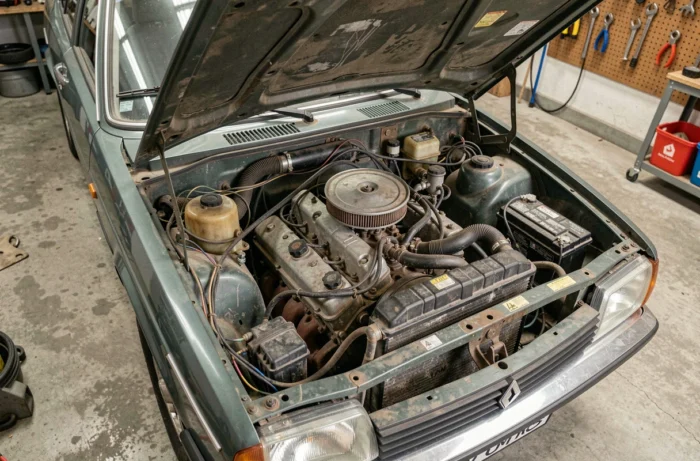
The Renault 30 TS, launched in 1975, received the aluminum PRV V6 with a 90° angle between banks. The fuel system uses a carburetor on the TS, replaced by fuel injection on the TX. Two transmissions are offered: a four-speed manual or a three-speed automatic.
The TX marks a qualitative leap in the range with its aluminum wheels and chrome central foot. The injection improves acceleration response while reducing consumption, a critical parameter with the second oil shock.
The 90° Angle and Its Effects on Engine Operation
A 90° V6 cannot achieve perfect balance. The irregularity of the firing intervals produces a characteristic sound and noticeable mechanical roughness. Drivers of the time see it as both a flaw and a temperament. PRV engineers integrated a balancing shaft and worked on the crankshaft mass to contain these vibrations.
Compared to BMW’s inline six-cylinders or Mercedes-Benz engines in the same segment, the PRV suffers from a lack of smoothness at low revs. Its compactness (it is shorter than an inline six) is, however, an asset for future transverse installation, which Renault will exploit in other models.
The Hatchback on a Touring Car: The Bodywork Gamble of the Renault 30
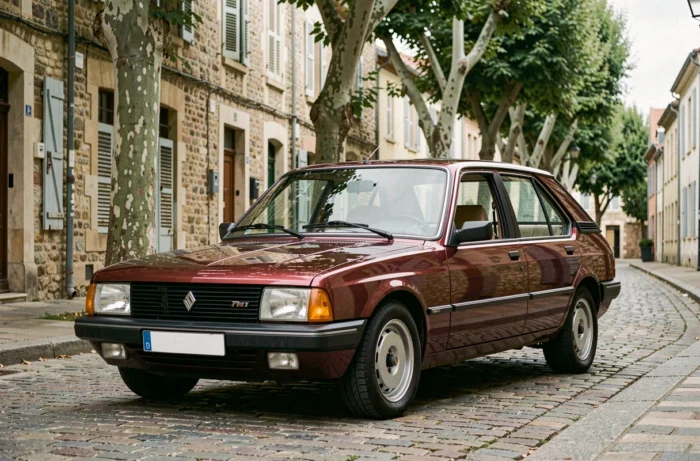
The design by Gaston Juchet adopts a two-and-a-half volume line with a sloping rear. This configuration increases the useful loading volume compared to a classic three-volume trunk.
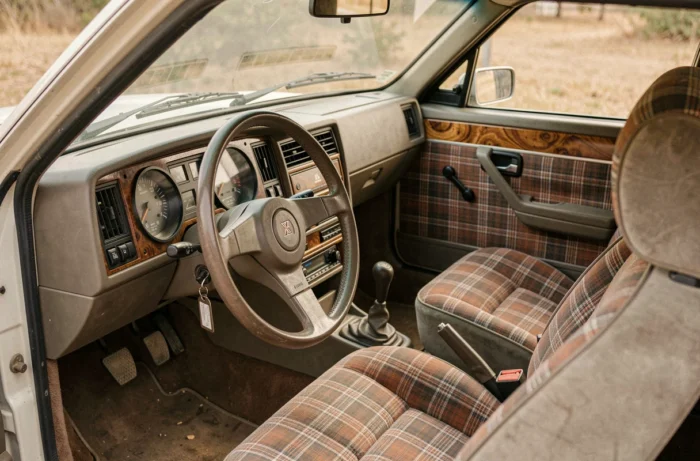
The problem lies elsewhere: the high-end French clientele associates hatchbacks with popular cars. Renault tries to counterbalance this perception with a high level of equipment (electric windows, power steering, velvet upholstery).
- Rear hatch with heated rear window, facilitating access to the loading area without a central hinge, a rare configuration in this segment at the time
- Independent rear suspension with trailing arms, offering a better comfort/road holding compromise than the rigid axles still present in some competitors
- Dashboard modified from the 1978 model year, with redesigned instrumentation and equipment upgrades in subsequent model years
Production and Key Versions of the Renault 30
136,403 units rolled off the production lines between 1975 and 1983. This modest volume reflects the relative commercial failure against German competition. The Peugeot 604, launched the same year with the same PRV engine, faces similar difficulties.
Several evolutions attempt to rekindle interest over the years:
- 1977 model year: modification of the engine fuel system, new door handles, aluminum surround around the headlights
- 1978 model year: redesigned dashboard, introduction of the R20 TS with the two-liter engine from the Française de Mécanique (Renault-Peugeot joint venture)
Current Rarity and Collectibility Interest
Finding a Renault 30 in good condition is a challenge. Corrosion has decimated the surviving fleet. The TX injection versions and the rare Turbo Diesel models attract the attention of collectors.
The market has not yet caught up with the value of equivalent Peugeot 604s, leaving a window of opportunity for discerning enthusiasts. The mechanical legacy of the Renault 30 has survived well beyond its commercial career: the PRV block has equipped cars as varied as the DeLorean DMC-12 and the Alpine A610.